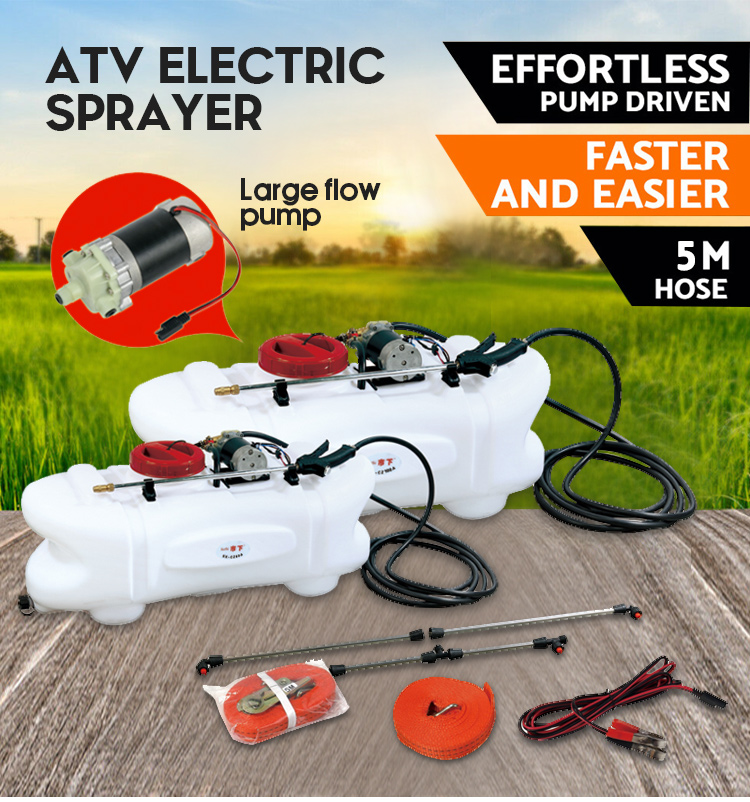
Managing weeds, pests, and fertilizer distribution presents a unique logistical challenge. Your acreage might be too rough or tightly spaced for traditional tractor setups. Conversely, the land is simply too large to cover efficiently using manual backpack equipment. This is where an ATV spray system bridges the gap. It offers mobility and efficiency for demanding terrain.
You have likely moved beyond basic operational questions. Now, you must evaluate equipment durability, payload safety, and application precision. Transitioning to an ATV-mounted solution requires careful planning. It demands more than picking the largest tank available. Successful deployment relies strictly on balancing multiple technical factors.
We will break down how to match pump capacity to your electrical system. You will learn the importance of respecting ATV suspension limits. Furthermore, we will explore boom configurations and chemical compatibility. These insights will help you build a reliable, high-performing field application system.
Key Takeaways
Core Function: An agriculture ATV sprayer relies on a 12-volt pump system to deliver precise fluid application across challenging terrain.
Component Evaluation: Longevity depends heavily on the quality of the ATV sprayer pump (diaphragm vs. roller) and structural features like breakaway boom hinges.
Payload Realities: Water weighs 8.3 lbs per gallon; sizing a sprayer requires strict adherence to your ATV’s rear rack weight capacity to prevent suspension damage or rollover risks.
Application Versatility: Configurations vary from spot-spraying wands to multi-nozzle booms, dictating efficiency for continuous pesticide spraying or localized weed control.
The Anatomy of an ATV Sprayer: How the System Functions
The 12-Volt Power Dynamics
Modern ATV spray systems pull electrical power directly from the vehicle battery. The ATV stator generates this current during engine operation. A standard 12-volt wiring harness connects the pump to the power supply. You must understand your vehicle electrical output before mounting any equipment. A mismatch here causes severe operational headaches.
High-capacity pumps draw significant amperage during continuous use. If your pump demands more amps than the stator produces, the battery drains rapidly. You might find yourself stranded in a remote pasture. Always cross-reference the pump amp draw against the owner manual specifications for your ATV. This ensures steady voltage and prevents premature electrical failures.
Fluid Delivery and Pressure Regulation
The application journey begins inside the main poly tank. Gravity feeds the liquid mixture down toward a primary suction line. Before reaching the mechanical components, the fluid passes through a mesh suction strainer. This vital filter catches debris and prevents clogs.
Next, the fluid enters the ATV sprayer pump. The pump pressurizes the liquid and forces it toward the distribution manifold. Pressure regulation determines your ultimate success. A bypass valve reroutes excess liquid back into the main tank. The pressure regulator maintains a consistent PSI. Consistent pressure guarantees uniform droplet sizes across your entire spray swath.
Dispersion Mechanisms (Wands vs. Booms)
Pressurized fluid requires a final delivery mechanism. Operators typically choose between spot-spraying wands and broadcast boom systems. These mechanisms translate raw pump pressure into effective ground coverage.
Spot-Spraying Wands: Operators use wands for manual targeting. They excel at hitting isolated thistles or treating specific fence lines. The wand provides pinpoint accuracy but lacks wide-area efficiency.
Broadcast Systems: Boom and boomless configurations handle large-scale dispersion. They distribute fluid evenly over wide paths. Booms offer precise swath control, while boomless nozzles sacrifice some precision for unmatched maneuverability in tight brush.
Evaluating an Agriculture ATV Sprayer: Component-Level Buyer’s Guide
Assessing the ATV Sprayer Pump
Evaluating an agriculture ATV sprayer starts at the pump. Entry-level models often use basic internal seals. These basic seals degrade quickly when exposed to harsh agricultural chemicals. Commercial-grade alternatives utilize robust diaphragm designs built for heavy-duty cycling. They handle abrasive solutions and thick mixtures much better.
Your primary decision metric involves internal valve materials. Look specifically for demand pumps utilizing chemically resistant components. Viton valves represent the industry standard for durability. They resist swelling and cracking when exposed to herbicides or liquid fertilizers. Choosing inferior seals guarantees premature failure and frustrating field repairs.
Boom vs. Boomless Nozzle Systems
Choosing your dispersion style dictates your field efficiency. Flat pastures demand different equipment than densely wooded trails. You must match the nozzle system to your dominant terrain.
An ATV sprayer boom provides precise, drift-controlled application. The physical structure keeps nozzles close to the ground. This ensures uniform coverage over flat pastures. However, structural booms face impact risks. You must select models featuring spring-loaded breakaway hinges. These hinges allow the arms to fold backward upon striking fence posts or trees. They automatically snap back into place, preventing costly metal fatigue.
Boomless systems use a single cluster of directional nozzles. They shoot fluid outward in a wide fan pattern. Operators favor them for navigating wooded areas. A physical boom would snag on brush and low-hanging branches in these environments. However, boomless setups are highly susceptible to wind drift. The fluid travels further through the air before hitting the target zone.
Feature
Folding Boom System
Boomless Nozzle System
Terrain Suitability
Flat pastures, open fields
Wooded trails, uneven ground, brush
Application Precision
High (even distribution)
Moderate (edges can thin out)
Wind Drift Risk
Low to Moderate
High
Impact Resistance
Requires breakaway hinges
Excellent (no extending arms)
Tank Construction and Agitation
Tank material quality directly impacts equipment lifespan. Sunlight degrades cheap plastics rapidly. You need thick-walled polyethylene construction. UV-resistant polymers prevent the tank from becoming brittle and shattering under stress. Check the wall thickness around mounting points, as these areas bear the most vibration.
Many agricultural chemicals settle quickly. Wettable powders easily separate from water within minutes. This separation ruins your application rates. You must utilize in-tank agitation. A return flow system routes pressurized fluid back into the bottom of the tank. This continuous churning keeps powders perfectly suspended during your entire run.
Sizing and Terrain Constraints (ATV vs. UTV Payload Realities)
The Physics of Fluid Weight
Many operators severely underestimate the physical load of full tanks. Liquid physics dictate strict mathematical boundaries for safe operation. A standard gallon of water weighs approximately 8.34 pounds. When you add heavy liquid fertilizers, the density increases further.
Follow this math to understand the real-world payload:
Calculate fluid weight: A 25-gallon tank holds over 208 pounds of liquid.
Add hardware mass: The poly tank, metal brackets, and pump often weigh 40 to 60 pounds empty.
Determine total load: You are placing roughly 260 pounds directly over the rear axle.
Overloading a standard ATV introduces severe risk factors. The extreme rear weight alters the vehicle center of gravity. This dynamic causes steering float, where the front tires lose traction. Ascending inclines becomes incredibly dangerous. The rear-heavy bias drastically increases rearward rollover risks.
When to Upgrade to a Heavy Duty ATV Sprayer or UTV Unit
A standard four-wheeler handles 15 to 25 gallons safely. Larger properties push these payload limits quickly. If your acreage requires frequent 40+ gallon applications, you face a distinct threshold. You must shift your evaluation parameters toward larger vehicles.
A heavy duty ATV sprayer mounted in a UTV bed solves these physics problems. UTVs feature much higher suspension tolerances. The cargo bed sits lower relative to the wheelbase. This lower center of gravity stabilizes the massive fluid load. The wider vehicle stance handles heavy sloshing safely on uneven terrain.
Best Practices for Pesticide Spraying and Chemical Compatibility
Nozzle Selection and Drift Management
Drift ruins crops and damages neighboring properties. Effective pesticide spraying requires strict droplet control. Standard flat-fan nozzles produce fine mists. High winds easily carry these tiny droplets away from your intended target area.
Air-induction nozzles solve this widespread problem. These specialized tips draw air into the fluid stream. They create larger, heavier droplets filled with tiny air bubbles. These heavy droplets plummet directly to the ground. They shatter upon impact, coating the leaf surface effectively. This mechanism ensures chemicals reach the target rather than vaporizing into the atmosphere.
System Calibration and Speed Matching
Hardware quality means nothing without proper calibration. Consistent application rates demand operational discipline. You cannot speed up and slow down arbitrarily. Fluctuating speeds drastically alter the amount of chemical hitting the soil per acre.
You must maintain a steady, GPS-verified speed. ATV speedometers often lack low-end precision. Rely on dedicated GPS units or smartphone apps for accurate pacing. Simultaneously, you must maintain stable pump pressure. Once you dial in the pressure regulator and establish a set speed, lock those parameters in. Any deviation ruins your chemical concentration ratios.
Post-Application Decontamination
Chemicals react poorly to one another. Herbicide residue left inside the plumbing creates disastrous cross-contamination. Imagine spraying a broadleaf weed killer on Tuesday. On Friday, you load liquid fertilizer to nourish your delicate crops. The residual herbicide mixes into the fertilizer, killing the exact plants you intended to feed.
Decontamination represents a mandatory maintenance phase. Always flush the tank completely. Run clean water through the pump, manifold, and nozzles. Introduce commercial tank neutralizers into the rinse cycle. These neutralizers break down sticky chemical binders. Triple-rinse the entire plumbing loop before storing the unit or changing chemical categories.
Implementation Risks and Troubleshooting Common Failures
Mounting and Securing
Forum discussions constantly highlight mounting failures. Flimsy nylon ratchet straps stretch during operation. They allow the tank to shift violently when navigating ruts. This shifting destabilizes the ATV and breaks plastic mounting tabs. You must use dedicated metal mounting brackets bolted securely to the rear rack.
Fluid sloshing introduces massive kinetic energy. When you hit the brakes, 200 pounds of liquid rushes forward. This wave can push the ATV off its intended path. Larger tanks require internal baffling. Baffles act as physical walls inside the tank. They break up the liquid wave, minimizing weight transfer and maintaining vehicle stability.
Winterization and Seal Protection
Cold weather destroys agricultural pumps. Improper winterization ranks as the number one cause of equipment failure. Operators often drain the tank and assume the system is safe. However, residual water always remains trapped inside the pump head cavity. When freezing temperatures arrive, this water expands into ice. The expansion cracks the plastic pump head and ruins the internal diaphragms.
Follow a strict winterization operating procedure:
Drain all visible water from the main tank and hoses.
Pour one gallon of non-toxic RV antifreeze into the tank.
Engage the pump and open the wand valve.
Wait until pure pink antifreeze exits the nozzle.
Activate the boom valves until pink fluid flows from every tip.
Shut off the system and store it out of direct sunlight.
This process coats the internal seals. It prevents cracking and ensures your equipment operates perfectly the following spring.
Conclusion
Selecting the right application system requires a disciplined evaluation process. You must prioritize ATV suspension payload limits first. Ignoring weight constraints leads to dangerous instability. Second, assess pump capacity and chemical compatibility. Choose internal seals capable of surviving harsh fertilizers. Finally, match your boom configuration to your specific terrain layout.
Take action before making a purchase. Calculate your exact acreage to determine optimal tank volume. Check your vehicle owner manual to verify the maximum rear rack weight capacity. Audit your primary chemical usage to ensure the plastics and seals resist corrosion. Taking these steps guarantees a safe, efficient, and long-lasting deployment.
FAQ
Q: What size ATV sprayer pump do I need for a 10-foot boom?
A: A 10-foot boom typically utilizes 4 to 6 nozzles. You must calculate the minimum GPM requirement per nozzle to maintain the spray pattern. Generally, a 2.2 to 3.0 GPM demand pump provides adequate flow. It ensures consistent pressure across all tips without starving the outer nozzles.
Q: Can I use a heavy duty ATV sprayer for thick fertilizers?
A: Yes, but you must select specific configurations. Thick fertilizers demand higher GPM pumps to push the viscous liquid. You also need larger diameter hoses to prevent flow restriction. Furthermore, constant return-flow agitation is mandatory to keep the heavy particulate suspended during application.
Q: Why does my ATV sprayer lose pressure during operation?
A: Pressure drops stem from three common issues. First, check the suction strainer for debris clogging the flow. Second, verify the ATV battery voltage, as dropping amps reduce pump speed. Finally, inspect the pump diaphragms. Worn or chemically degraded internal seals lose their ability to build pressure.
Q: Is a boomless nozzle better than a folding boom?
A: It depends entirely on your environment. Boomless nozzles excel in wooded or highly uneven terrain where physical arms would snag. However, folding booms are vastly superior for precise, uniform coverage on flat pastures. Booms keep nozzles low, drastically reducing wind drift compared to boomless systems.
Shixia Holding Co., Ltd. was establishes in 1978, that has more than 1,300 employees and more than 500 sets of various injection molding machines, blow molding machines and other advanced equipment.