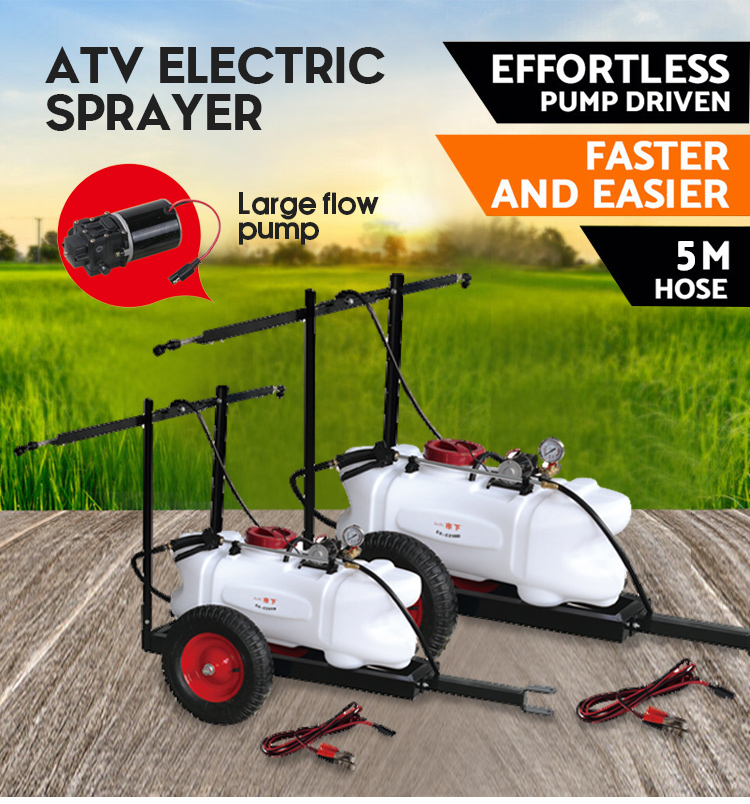
Replacing manual application with a dedicated agriculture ATV sprayer drastically reduces field time. However, selecting the wrong unit leads to uneven application, burned-out pumps, or severe ATV suspension damage. For bottom-of-funnel buyers, the decision isn't whether to spray. Instead, you must figure out how to match tank capacity, pump flow rate (GPM), and boom setup to specific terrain and chemical requirements. You need equipment tailored precisely to your property layout. A reliable farm ATV sprayer must balance the payload limits of your vehicle against the exact coverage needs of your acreage. This delicate balance ensures consistent operating pressure and vital chemical compatibility. In the following sections, we will explore how to size your tank appropriately. We will examine pump specifications thoroughly and evaluate boom configurations for diverse agricultural landscapes.
Key Takeaways
Match Tank to Payload: ATV suspension limits typically restrict tank sizes to 15–25 gallons; exceeding this risks vehicle damage and rollover from liquid surge.
GPM Over PSI: For broadcast spraying, pump flow rate (Gallons Per Minute) is a more critical baseline metric than maximum pressure (PSI).
Boom vs. Boomless: Boom sprayers offer precise edge control, while boomless nozzles excel in rough, wooded, or uneven terrain where physical booms would snag.
Component Quality Matters: Long-term reliability relies on UV-stabilized polymer tanks, chemical-resistant pump seals (e.g., Viton), and reinforced wiring harnesses.
Defining Your Application and Acreage Requirements
Assessing Farm Size vs. Tank Capacity
You must calculate your active spray area first. This crucial initial step determines a realistic tank size for your machine. You should never guess your acreage when purchasing field hardware. A standard 15-gallon tank generally covers approximately one to two acres per fill. This coverage depends heavily on your specific nozzle flow rate and your driving speed across the pasture. If you drive too slowly, you will over-apply the chemical and drain the tank rapidly.
If you manage extensive pastures, you face a critical limitation check. Buyers needing a large acreage sprayer should evaluate if an ATV unit truly makes sense. Sometimes, a tow-behind model becomes completely necessary to limit excessive refill downtime. An ATV simply cannot carry 50 gallons safely on its rear rack. Keep your specific vehicle payload restrictions in mind at all times.
Identifying Chemical Applications
Next, identify your exact chemical applications. Different chemicals demand distinct equipment capabilities. You must classify what liquids you intend to distribute across your fields.
Herbicides: You must choose between spot treatment and broadcast application. Spot treating requires less fluid volume but demands greater wand precision to avoid killing non-target plants.
Liquid Fertilizers: These thick, heavy suspensions require higher internal tank agitation. They also need specific, robust pump tolerances to avoid severe clogging inside the diaphragm housing.
Pesticides and Fungicides: These aggressive formulas usually require much higher PSI from the pump. Increased pressure creates a fine mist necessary for deep, effective canopy penetration in dense crops.
Many beginners make a critical mistake here. They buy a small tank for a massive farm simply to save a few dollars upfront. This error leads to endless, frustrating refill trips back to the water source. Others buy a massive tank that crushes their suspension. Always prioritize proper vehicle balance over maximum volume. Measure your actual treatable land area accurately before selecting a tank size.
Core Specifications of a Farm ATV Sprayer
Pump Selection: GPM and PSI Ratios
Selecting the right pump involves balancing Gallons Per Minute (GPM) and Pounds per Square Inch (PSI). Most ATV electric sprayer setups use standard 12-volt systems connected directly to the vehicle battery. These reliable pumps typically offer flow rates ranging from 1.0 to 5.5 GPM.
You must apply strict decision logic here. Spot spraying heavily relies on localized application. It only requires 1.0 to 2.2 GPM. You do not need massive flow for a single wand operation. Conversely, multi-nozzle boom setups demand at least 3.0 GPM. Higher flow prevents drastic pressure drops at the outer nozzles. If your outer nozzles drip instead of producing a wide fan, your pump lacks sufficient GPM to push the fluid effectively.
Boom Configurations (Precision vs. Terrain)
You must also match your boom configuration to your specific terrain layout. Physical booms and boomless setups serve entirely different agronomic purposes.
Folding booms work best for flat, open pastures. They guarantee exceptionally even liquid distribution across the entire swath. Furthermore, physical booms minimize dangerous wind drift by keeping nozzles close to the ground. Look for models featuring spring-loaded breakaway hinges. These intelligent hinges prevent catastrophic boom arm damage if you accidentally strike a hidden fence post or large rock.
Boomless nozzles excel along complex fence lines, steep ditches, and heavily wooded areas. They spray a massive wide pattern without extending a vulnerable metal arm into harm's way. However, you must note a major caveat. Boomless setups remain highly susceptible to wind drift. They perform poorly for precision application near sensitive adjacent crops. A sudden gust of wind can carry herbicide directly into a neighboring vegetable garden.
Handgun and Hose Quality
Finally, carefully evaluate the handgun and hose quality. Look for a heavy-duty hose length measuring between 15 and 25 feet. This specific length allows comfortable reach around the vehicle without causing excessive, frustrating tangling. Always choose wand tip materials carefully. Brass tips offer far better long-term durability over cheap plastic alternatives. Plastic tips wear out rapidly from chemical abrasion, which quickly ruins your desired spray pattern.
ATV Sprayer vs. 3-Point Hitch Equipment
Mobility and Soil Compaction
ATVs exert significantly less ground pressure than heavy utility tractors. This physical trait makes them absolutely ideal for early spring applications. You can safely navigate wet, soggy fields without causing severe rutting. Heavy tractor tires cause deep soil compaction during wet seasons. Soil compaction ultimately reduces crop yields by restricting vital root growth and halting proper water drainage. Utilizing lighter equipment preserves your field's soil structure.
Setup Speed and Convenience
Setup speed offers another major, undeniable advantage. ATV units provide much faster deployment for small, immediate field tasks. You save considerable time compared to hitching standard field spraying equipment to a utility tractor. If you spot a patch of invasive thistles, you can deploy the ATV setup in mere minutes. Tractor implements require aligning complex PTO shafts, adjusting lifting pins, and securing heavy steel frames.
Capacity Limitations (The Trade-off)
However, you must accept certain strict capacity limitations. This dynamic represents the primary trade-off between the two distinct equipment classes. Standard 3-point tractor sprayers easily handle 50 to 150 gallons of liquid. ATVs remain strictly limited by the manufacturer's maximum rear rack weight capacity.
Remember, pure water weighs approximately 8.3 pounds per gallon. Add the dry tank weight, the pump, and the boom metal, and you quickly approach critical safety limits. Loading 25 gallons of water places over 200 pounds directly over your rear axle.
Equipment Capacity and Feature Comparison
Feature
ATV Sprayer Setup
3-Point Hitch Sprayer
Ideal Acreage Use
Small to Medium scale
Large commercial farming
Soil Compaction Risk
Very Low (Excellent for wet soil)
High (Heavy tractor weight)
Deployment Time
Fast (Under 5 minutes)
Slow (Requires complex hitching)
Maximum Liquid Capacity
15–25 Gallons safely
50–150+ Gallons
Hardware Durability and Safety Considerations
Liquid Surge and Vehicle Stability
Hardware durability directly impacts operator safety in the rough field. Look specifically for internally baffled tanks. Sloshing liquid shifts the vehicle's center of gravity unexpectedly and violently. This sudden movement poses a severe rollover risk, especially when you operate on steep inclines or uneven ditch banks. Internal baffles physically break up the internal wave action inside the tank. They keep the liquid stable while you maneuver over unpredictable terrain.
Material Integrity and Chemical Resistance
You should also evaluate tank material integrity closely. Manufacturers must include strong UV inhibitors in the polyethylene plastic blend. These chemical inhibitors prevent structural degradation and dangerous photo-reactions under intense, direct sunlight. Without UV protection, a plastic tank becomes brittle, fades, and eventually cracks within just two summer seasons.
Furthermore, verify the presence of chemical-resistant seals throughout the system. Viton valves and diaphragms withstand caustic agricultural chemicals far better than standard rubber. Standard rubber swells, warps, and deteriorates rapidly when repeatedly exposed to aggressive herbicides and liquid fertilizers.
Electrical Draw and Battery Life
Lastly, pay strict attention to the system's electrical draw. Ensure the 12-volt pump's amp draw does not exceed your ATV stator’s maximum charging output. Pulling too many amps can easily drain the battery during continuous, all-day field operation. You do not want to end up stranded in the back pasture with a dead battery.
Common Electrical Best Practices
Always inspect your ATV's stator output rating in the manual before buying a high-GPM pump.
Run dedicated, heavy-gauge wire directly from the battery terminals to the pump switch.
Install an inline fuse immediately near the battery to protect your wiring harness from unexpected power surges.
Keep the ATV engine running continuously while spraying to maintain proper battery charge voltage.
Implementation Steps and Shortlisting Logic
Follow a logical progression to shortlist your final equipment choices. We strongly recommend these sequential steps to ensure you buy the exact right unit for your specific landscape. Skipping these fundamental steps often leads to profound buyer's remorse or broken equipment.
Step 1: Check ATV Specs: Find the exact rear rack weight limit in the ATV owner's manual. Do this critical check before looking at tank sizes. Never guess your rack capacity. Exceeding it bends the tubular frame, destroys your suspension, and voids your vehicle warranty entirely.
Step 2: Map the Terrain: Choose your boom configuration based entirely on your local field obstacles. Map out narrow gates, steep ditches, and dense tree lines. Factor in the typical wind prevalence in your specific geographic region. Choose boomless nozzles for rough terrain, and folding booms for flat, open pastures.
Step 3: Verify the Warranty and Parts Availability: Exclude brands lacking robust post-purchase support. Commercial-grade field use strictly requires readily available replacement parts. You need reliable access to replacement pumps, spray nozzles, and inline strainers. If a manufacturer does not sell individual parts, treat the whole unit as disposable.
Avoid extremely cheap models heavily reliant on thin, unreinforced plastics. Check the wiring harness connectors for adequate weather-proofing. Standard automotive connectors corrode rapidly when exposed to airborne fertilizer salts. Look for sealed, marine-grade electrical connections instead. They withstand harsh agricultural environments far better.
Conclusion
Choosing the right equipment requires a careful payload calculation. You must weigh your vehicle capacity against required pump flow rates and terrain-specific nozzle configurations. The ultimate goal is achieving uniform chemical coverage safely and efficiently. First, review your vehicle's structural weight limits immediately. Next, calculate your required GPM based on your preferred boom setup. Finally, shortlist models featuring chemical-resistant components and readily available replacement parts. Do not compromise on internal tank baffles or internal seal durability. A proper selection guarantees years of efficient weed control and simplified pest management across your property.
FAQ
Q: Can I run a 5.5 GPM electric pump on a standard ATV battery?
A: Yes, but continuous running requires the ATV engine to be operating to maintain battery charge. High-GPM pumps pull significant amperage; consider upgrading wiring with an inline fuse directly to the battery.
Q: Are boomless ATV sprayers less effective than boom sprayers?
A: They are equally effective for broad coverage but lack precision. They are not recommended for spraying near adjacent sensitive crops due to unpredictable wind drift.
Q: How do I prevent my ATV sprayer pump from burning out?
A: Never run the pump dry, always use an inline strainer to catch debris before it enters the diaphragm, and perform strict winterization (flushing with antifreeze) to prevent cracked seals.
Q: What is the maximum safe tank size for a standard farm ATV?
A: Most utility ATVs safely handle 15 to 25 gallons on the rear rack. A 25-gallon tank full of water adds over 200 lbs, which often approaches or exceeds the rack’s safe operating limit. Always verify your specific machine's manual.
Shixia Holding Co., Ltd. was establishes in 1978, that has more than 1,300 employees and more than 500 sets of various injection molding machines, blow molding machines and other advanced equipment.