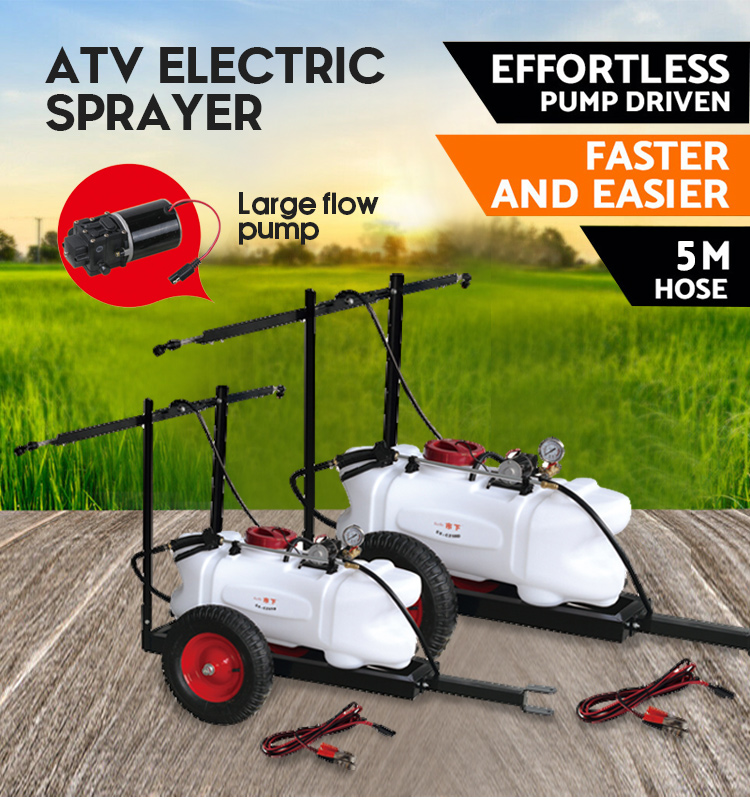
Managing rural land effectively requires equipment tailored to your specific environment. Many landowners struggle to match their daily equipment to their actual acreage. Undersizing a sprayer leads to frustrating downtime. You find yourself constantly driving back to refill the tank instead of working. Conversely, oversizing your equipment brings serious operational risks. A tank too large can cause severe suspension damage to your vehicle, while also wasting valuable capital on unneeded capacity.
Coverage is never dictated just by the size of your tank. It depends entirely on the dynamic relationship between application rate (Gallons Per Acre or GPA), pump flow (Gallons Per Minute or GPM), and your vehicle speed. You need accurate data to set up a functional system. This guide provides the exact math and operational realities you need. We will help you evaluate if an agriculture ATV sprayer truly fits your specific land management requirements.
Key Takeaways
A standard 25-gallon agriculture ATV sprayer typically covers 1.25 to 2.5 acres per tank, depending on the chemical’s required application rate (usually 10–20 GPA).
Usable ATV sprayer capacity is strictly limited by the ATV's rear rack weight rating; liquids add roughly 8.3 lbs per gallon, making tanks over 40 gallons unsafe for most standard four-wheelers.
Achieving an accurate farm coverage rate requires strict sprayer calibration to align pump pressure, nozzle type, and driving speed.
If your continuous spray area exceeds 5-7 acres, the logistics of refilling an ATV sprayer usually warrant upgrading to a UTV or 3-point tractor sprayer.
The Core Math: Determining Your Farm Coverage Rate
Many first-time buyers guess how much ground they can cover based solely on tank volume. This approach often leads to poor weed control or scorched pastures. You need a reliable mathematical baseline to understand your true farm coverage rate. Calculating your coverage is straightforward once you know the core variables.
The Universal Coverage Formula
You can determine your maximum acreage per tank using a simple equation. You must divide your tank capacity by the target application rate. The application rate is measured in Gallons Per Acre (GPA).
Tank Capacity (Gallons) ÷ Application Rate (GPA) = Total Acres Covered per Tank
For example, if you run a 25-gallon tank and apply at 15 GPA, your math looks like this: 25 ÷ 15 = 1.66 acres. You cannot change this mathematical reality. If you want to cover more land, you must either increase your tank size or safely lower your GPA.
Chemical Labeling Dictates the Math
You cannot arbitrarily decide to use less water just to cover more ground. The herbicide, pesticide, or fertilizer label serves as your ultimate baseline. Chemical manufacturers spend millions testing their products. They define exactly how much water is needed to carry the active ingredient effectively. If a label demands 15 GPA for proper foliar coverage, you must follow it. Stretching the tank by driving faster or lowering pressure will sacrifice efficacy. You will leave weeds alive or fail to fertilize the crop properly.
Pump Sizing Constraints
Your pump flow, measured in Gallons Per Minute (GPM), must adequately match your boom and nozzle output requirements. You cannot attach a massive boom to a tiny pump. For instance, a small 2.2 GPM pump cannot adequately run a wide 5-nozzle boom at high pressure. The pump will constantly run at maximum capacity, overheat, and fail to deliver an even spray pattern. You must ensure your pump produces enough flow to feed every nozzle while maintaining enough reserve pressure to agitate the tank.
Example: Matching Pump GPM to Nozzle Output
Pump Size (GPM)
Ideal Number of Nozzles
Best Application Scenario
1.0 - 1.2 GPM
Spot wand only
Individual weed targeting, very small plots.
2.0 - 2.2 GPM
2-3 nozzle boom
Narrow trails, fencelines, small food plots.
3.0 - 4.0 GPM
5-7 nozzle boom / Boomless
Pastures, wide continuous coverage, high pressure.
Evaluating ATV Sprayer Capacity: 15, 25, and 40 Gallons
Selecting the right ATV sprayer capacity requires balancing your land size against the physical limits of your four-wheeler. You must consider both the total volume needed and the safety implications of carrying heavy liquids over uneven terrain.
Spot Sprayers (15 Gallons)
A 15-gallon tank is highly compact and lightweight. It mounts easily to almost any ATV, including smaller 250cc models, without altering the vehicle's center of gravity.
Best for: Fencelines, small food plots, and targeted weed control around buildings.
Coverage: Expect to cover approximately 0.75 to 1.5 acres per tank, depending on your GPA requirements.
These units excel in tight spaces. However, they become frustratingly tedious if you try to use them for broad field applications. You will spend all your time refilling.
The Standard: 25 Gallon Sprayer
The 25-gallon tank represents the industry standard for a reason. It strikes the perfect balance between useful fluid volume and vehicle stability. Understanding your 25 gallon sprayer coverage is vital for most medium-sized land management tasks.
Best for: Pasture maintenance, medium food plots (1–3 acres), and trail management.
Coverage: You will typically cover 1.25 to 2.5 acres per fill.
This capacity allows you to finish small fields without stopping. It also keeps the total liquid weight around 210 pounds. Most standard utility ATVs can handle this weight on their rear rack safely.
The Upper Limit (40 Gallons)
Pushing into the 40-gallon territory requires serious caution. You get excellent continuous run time, but you sacrifice maneuverability and introduce safety risks.
Best for: Flat terrain and larger, highly uniform lots.
Coverage: Roughly 2 to 4 acres per tank.
Implementation Risk: Water is heavy. Forty gallons of liquid weighs over 330 pounds. When you add the weight of the empty tank and pump, you easily push 360 pounds.
This massive weight creates severe liquid sloshing. This kinetic weight shift can easily flip an ATV on uneven terrain. You will also test the absolute limits of standard ATV suspension springs. You should strictly avoid 40-gallon units if you operate on hills, deep ruts, or side slopes.
Operational Variables That Impact True Coverage
Your theoretical math will only get you so far. Real-world conditions dramatically shift how much ground you actually cover. You must account for hardware choices, logistical challenges, and electrical limits when planning your work day.
Boom vs. Boomless Nozzles
The hardware you use to distribute the liquid fundamentally changes your operational strategy.
Boom Systems deliver highly precise, wind-resistant coverage. The nozzles sit close to the ground. This physical proximity ensures uniform application rates across the field. They are best when you need exact chemical distribution. However, booms become incredibly cumbersome in wooded or brush-heavy areas. You will constantly snag the arms on trees or fence posts.
Boomless Systems offer a completely different experience. They use a single nozzle cluster to cast water in a wide swath, often up to 30 feet. You can maneuver easily through dense woods or uneven terrain without worrying about breaking hardware. However, they have a major flaw. They are highly susceptible to wind drift. A slight breeze can blow your expensive chemicals off-target. This drift wastes chemicals and drastically reduces your effective acreage per tank.
Refill Logistics (The Hidden Bottleneck)
Many operators obsess over their tank size while ignoring transit time. Refill logistics often become the true bottleneck of any operation. High-capacity spraying on an ATV often fails because of travel time, not vehicle capability.
If you spray a back pasture located two miles from your water source, you face a major problem. You might drain your 25-gallon tank in just 15 minutes of spraying. Then, you spend 30 minutes driving back to the water nurse tank, 15 minutes filling up, and 30 minutes driving back. In this scenario, the operator spends 60% of their day just commuting. You must factor distance to water into your efficiency expectations.
Battery and Electrical Draw
Your 12-volt pump draws continuous power from your vehicle. You must assess the strain of continuous pump operation on an ATV’s stator and battery. This becomes critical at low speeds. When you drive 3 to 4 MPH, your ATV's charging system is less efficient. It might not generate enough power to replace what the pump consumes. Over several hours, you can drain the battery completely. You might find yourself stranded in the field with a dead vehicle. Always monitor your battery health and consider upgrading your battery if you plan on all-day operations.
Sprayer Calibration: Eliminating Guesswork and Chemical Waste
You cannot achieve professional results by guessing your vehicle speed or your pump output. You must implement accurate sprayer calibration before you open any chemical bottles.
Why Calibration Matters
Skipping this step guarantees one of two bad outcomes. First, you might under-apply the chemical. The weeds will survive, and you will have to repeat the entire process, wasting hours of labor. Second, you might over-apply the chemical. This error causes severe crop or pasture damage and wastes a tremendous amount of expensive product. Calibration ensures your actual output matches the chemical manufacturer's strict target GPA.
The 3-Step Calibration Framework
Professional land managers follow a strict, easy-to-replicate framework to lock in their application rates.
Measure Speed: You need a consistent baseline speed. Mark off exactly 100 feet in a field similar to your target area. Drive the ATV across this distance at a comfortable, consistent RPM and gear. Use a stopwatch to time the run in seconds. Convert this time into Miles Per Hour (MPH).
Measure Output: Park the ATV. Fill the tank with plain water. Turn the pump on and set it to your normal operating pressure. Catch the water from a single nozzle into a measuring jug for exactly one minute. This gives you Ounces Per Minute (OPM).
Adjust the System: Compare your findings against standard calibration charts provided by your nozzle manufacturer. If you are applying too much water, you can slightly increase your ATV speed or lower the pressure regulator. If you are applying too little, you can slow down or change to a larger nozzle tip. Continue tweaking until your real-world output perfectly aligns with the required GPA.
Decision Framework: When to Choose an Agriculture ATV Sprayer vs. Alternatives
An ATV setup provides incredible utility, but it is not a magic bullet for every property. You must honestly evaluate your land volume to decide if a four-wheeler is the correct host vehicle.
Shortlisting an ATV Sprayer
You should absolutely choose an ATV system if you fit a specific profile. It is ideal for buyers managing 1 to 5 acres of continuous spraying. It shines in environments with tight tree lines, rough trails, or narrow gates. Furthermore, if you already own a reliable ATV, utilizing this existing asset dramatically minimizes your initial capital expenditure.
When to Upgrade to a UTV (60-100 Gallons)
A standard four-wheeler will exhaust you on larger properties. You should upgrade to a UTV system when covering 5 to 15 acres. Side-by-sides boast significantly higher payload capacities. They can safely carry 60 to 100 gallons of liquid without compromising suspension safety. UTVs also support higher GPM pumps. This allows you to run longer, wider booms, dramatically cutting down your total field passes.
When to Upgrade to a 3-Point Tractor (150+ Gallons)
If your property continues to grow, you eventually outgrow recreational vehicles entirely. A 3-point tractor sprayer becomes strictly necessary for commercial agriculture and large-scale pasture management. These systems handle 150 gallons or more with ease. They utilize powerful PTO-driven pumps instead of 12-volt electrical pumps, offering unmatched pressure stability. You also gain the ability to integrate precise field mapping and GPS auto-steer technologies.
Conclusion
Evaluating your coverage needs relies on solid math and honest operational assessments. An ATV-based setup serves as a brilliant precision tool for light-to-medium acreage. However, its effectiveness is strictly bounded by weight safety limits and the chemical application rates you must follow.
Calculate the precise GPA required by your most frequently used chemical. Then, carefully assess the distance from your target field to your clean water refill station. Choose a tank capacity that comfortably handles your average plot size while keeping the total rear-rack weight well under your vehicle manufacturer's safety limit.
As a next step, you should review your specific ATV's payload specifications in the owner's manual. Once you confirm your weight limits, you can confidently browse specific 25-gallon models and determine if a boom or boomless nozzle setup suits your terrain.
FAQ
Q: How many acres will a 25 gallon sprayer cover?
A: A standard 25-gallon tank will cover between 1.25 to 2.5 acres per fill. This range strictly depends on the chemical you use. Most agricultural chemicals require an application rate between 10 and 20 Gallons Per Acre (GPA) to achieve effective foliar coverage.
Q: How fast should I drive an ATV while spraying?
A: You should maintain a steady speed of 3 to 5 MPH. This speed represents the sweet spot for ATV applications. It prevents excessive bouncing on rough terrain, ensures consistent nozzle coverage, and allows your 12-volt pump to maintain steady line pressure without surging.
Q: Can I put a 40-gallon sprayer on a 300cc ATV?
A: You should avoid this setup. A full 40-gallon tank weighs roughly 330 pounds, excluding the hardware. This payload exceeds the rear rack capacity of most mid-size 300cc ATVs. It creates severe suspension sag and introduces dangerous kinetic sloshing that can flip the vehicle.
Q: What pump size (GPM) do I need for a 10-foot boom?
A: A 10-foot boom typically uses 3 to 5 nozzles. You need a minimum of a 3.0 to 4.0 GPM pump to support this width. This ratio ensures you supply enough water volume to every nozzle while maintaining adequate system pressure for an even spray pattern.
Shixia Holding Co., Ltd. was establishes in 1978, that has more than 1,300 employees and more than 500 sets of various injection molding machines, blow molding machines and other advanced equipment.