Property owners and landscape managers face a relentless cycle every summer. They spend excessive capital on monthly utility bills. Yet, delicate garden plants still struggle during peak heat. Traditional watering methods fail because they waste massive amounts of water. Rapid evaporation, wind drift, and surface runoff are the main culprits. Frequent, heavy watering sessions look effective on the surface. However, the moisture rarely penetrates deep into the soil profile where root systems actually thrive.
Recently, shifting climate patterns and stricter municipal water regulations have forced a massive transition in landscape architecture. The industry is rapidly moving away from inefficient flood and spray methods. Instead, the focus has shifted entirely to precision water management. The most effective, scientifically backed solution to this commercial and residential hurdle is drip irrigation. This highly efficient, targeted watering method delivers moisture directly to the base of the plant. This strategic approach ensures the root zone receives a consistent, measured supply of water. It completely eliminates the collateral waste associated with overhead spraying. Whether managing a small collection of raised vegetable beds or overseeing a sprawling commercial landscape, understanding how these systems operate is the critical first step toward a healthier, lower-maintenance yard.
Key Takeaways
Clear Definition: Drip irrigation is a precise, low-pressure watering method. It delivers water drop-by-drop directly to plant roots, drastically minimizing evaporation and surface runoff.
Unmatched Efficiency: Field studies show these systems operate at up to 90% efficiency. This saves substantial amounts of water and capital compared to traditional overhead sprinkler setups.
Core Components: A functional, leak-free setup relies on a strict sequence of hydraulic hardware. This includes a backflow preventer, mesh filter, pressure regulator, distribution tubing, and specialized emitters.
Versatile Design: The modular nature of micro-irrigation allows it to be mathematically customized. It works flawlessly for dense shrubbery, potted plants, and large-scale agricultural operations alike.
Streamlined Assembly: With a proper engineering plan, installation becomes a logical, straightforward process. Routine maintenance guarantees years of reliable operation.
Defining Drip Irrigation in Modern Landscaping
To fully grasp the mechanics of this watering method, we must start with the foundational terminology. Hydraulic engineers define this as a highly efficient micro-irrigation system designed to conserve both water and localized soil nutrients. It achieves this by allowing water to drip slowly and deliberately to the root zones of plants. This delivery can occur from above the soil surface using specialized emitters. Alternatively, it can be buried directly below the surface via subsurface drip lines. By operating at low pressure and low volume, the technology completely eliminates the chaotic, broad spray of traditional methods.
Beyond a simple textbook definition, the history and global impact of this technology reveal its critical role in modern agriculture. Consider these technical insights regarding its development.
Agricultural Origins: Modern drip technology was heavily pioneered in arid environments during the 1950s. Engineers discovered that a slow, steady release of water caused exponential plant growth compared to high-volume flooding methods.
Global Water Conservation: Empirical agricultural data indicates that switching to micro-irrigation reduces water usage by 30% to 70% globally. This makes it a cornerstone technology for drought-prone regions facing strict municipal watering bans.
Passive Weed Reduction: Water is applied exclusively to the specific root zone of the desired plant. Consequently, the surrounding topsoil remains bone dry. This targeted approach physically starves dormant weed seeds of the surface moisture required for germination.
Looking at current landscaping trends, there is a massive industry shift toward sustainable water management. Both residential developers and commercial agricultural sectors are rapidly adopting smart drip technologies. Industry analysts note that integrating automated micro-irrigation is no longer viewed as just a niche upgrade. Rather, it is becoming a standard baseline requirement for modern, climate-resilient landscape architecture.
System Anatomy and Core Component Specifications
A reliable setup is not just a punctured garden hose. It is a precisely engineered sequence of valves, filters, and regulators designed to control pressure and regulate flow. Understanding this hydraulic anatomy is non-negotiable for proper system sizing and component selection.
The Source and Control Hub
The starting point dictates exactly how and when water enters the network.
Automated Controller: Acting as the brain of the setup, modern controllers dictate specific days and durations. Advanced models synchronize with local weather data to prevent watering during rainstorms.
Backflow Preventer: This is a mandatory safety device required by municipal plumbing codes. It utilizes a mechanical one-way valve. This ensures stagnant garden water cannot siphon backward into the clean drinking water supply.
Filtration and Pressure Regulation
Standard municipal water pressure is far too aggressive for delicate micro-irrigation parts. Furthermore, unfiltered water will quickly ruin the entire network.
Mesh Filter: Even clean drinking water contains microscopic sediment or mineral particulates. A commercial-grade 120 to 150-mesh screen filter must be installed immediately after the backflow preventer. This traps particles before they clog the tiny pathways inside the emitters.
Pressure Regulator: Standard residential water pressure typically ranges from 50 to 70 Pounds per Square Inch, known as PSI. High-quality pressure regulators step this intense kinetic energy down to a stable 15 to 30 PSI operating range. Without this crucial component, delicate plastic tubing and barbed fittings easily rupture under stress.
The Distribution Network
Once the water is filtered and regulated, it must be transported efficiently across the landscape.
Mainline Poly Tubing: Generally 1/2-inch or 3/4-inch in diameter, this flexible black polyethylene tubing acts as the primary artery. It carries the bulk of the water from the source to various planting zones.
Micro-Tubing: Typically 1/4-inch in diameter, these smaller secondary tubes branch off from the mainline. They easily navigate around rocks and thick stems to deliver water directly to isolated plants.
Emitters and Drippers
The endpoints of the system are where the actual precision watering occurs.
Precision Emitters: These small plastic devices are inserted into the tubing to dictate the precise flow rate. They are rated in Gallons Per Hour, or GPH. Common agricultural sizes include 0.5, 1.0, and 2.0 GPH outputs.
Pressure-Compensating Technology: Professional-grade Pressure-Compensating, or PC, drip emitters contain a specialized internal silicone diaphragm. This ensures a perfectly uniform flow rate regardless of elevation changes in the yard or pressure fluctuations along a long line of tubing.
Fluid Mechanics: How the System Operates in the Field
Understanding the physical journey of the water clarifies exactly why this method is remarkably effective. The mechanics operate through a carefully controlled sequence of pressure reduction followed by localized distribution.
The Hydraulic Journey
When a scheduled watering cycle begins, the water follows a strict, controlled path from the spigot to the soil.
Valve Activation: The automated timer reaches its programmed start time. It electronically opens the main valve, allowing municipal water to flow into the manifold.
Purification and Safety: The water immediately pushes through the backflow preventer. It then passes through the fine mesh filter, stripping away suspended solids or sediment.
Pressure Reduction: The high-velocity water hits the pressure regulator. This component restricts the flow, dropping the kinetic energy down to a gentle, manageable 25 PSI.
Distribution: This low-pressure water travels silently through the main poly tubing network. It fills the entire system uniformly before branching into the smaller micro-tubes.
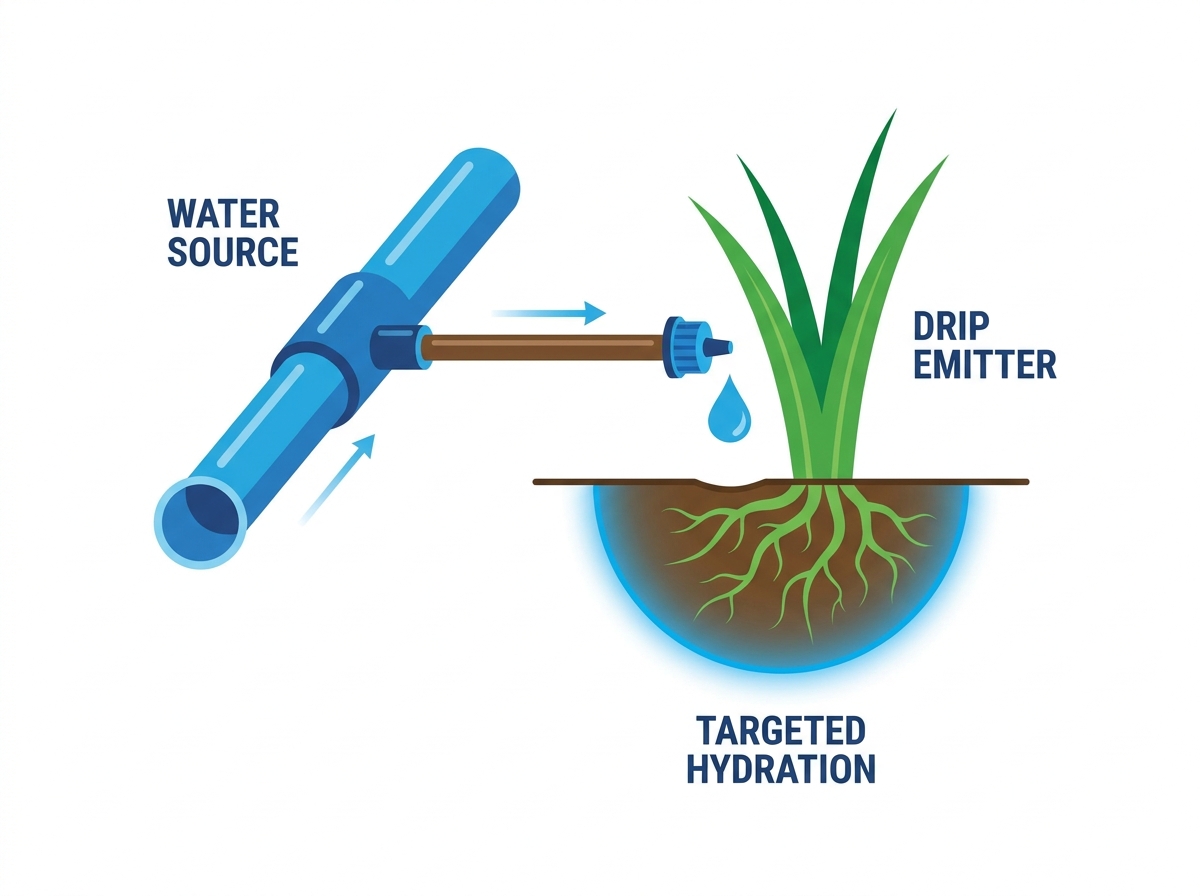
Precision Release: Finally, the water reaches the individual emitters. The internal diaphragms restrict the water further, forcing it to release drop-by-drop directly onto the soil surface.
Capillary Action in the Soil Matrix
Once the water leaves the emitter, soil physics takes command. Instead of pooling on the surface and running off into the street, the slow drip leverages capillary action. Because the water is applied slowly, the dirt acts like a giant sponge. It draws the moisture outward and downward in a wide subterranean teardrop shape. This deep, consistent moisture profile encourages plant roots to stretch downward. The biological result is a stronger, deeply anchored, and highly drought-resilient root system.
Comparative Efficiency and Commercial Value
The decision to transition to micro-irrigation is driven by environmental responsibility, plant health optimization, and long-term financial strategy. The empirical benefits of these systems are undeniable when compared directly to traditional setups.
Performance Metric
Precision Drip Irrigation
Traditional Overhead Sprinklers
Water Efficiency
90% to 95%
50% to 65%
Evaporation Loss
Near zero
Extremely high
Weed Proliferation
Minimal surface moisture starves weeds
High moisture encourages weed growth
Foliar Disease Risk
Low, leaves remain completely dry
High, wet leaves breed fungal pathogens
Operating Pressure
15 to 30 PSI
40 to 65 PSI
Traditional sprinklers lose a massive percentage of their volume to the atmosphere. Wind drift carries droplets away from the target area. Meanwhile, the sun evaporates surface water before it can penetrate the topsoil. By delivering water directly to the base of the plant at a slow rate, drip systems virtually eliminate runoff.
Furthermore, fungal pathogens thrive in environments where plant foliage remains consistently wet. Because drip irrigation applies water exclusively to the root zone, the leaves, stems, and flowers remain completely dry. This drastically reduces the incidence of powdery mildew and root rot. Commercially, this translates to massive financial savings. Property owners spend far less capital replacing dead landscaping or purchasing harsh chemical fungicides.
No two landscapes share identical hydrology. Therefore, the layout and component selection must be mathematically tailored to the specific environment, plant types, and soil texture of the outdoor space.
High-Density Plantings and Raised Beds
Dense vegetable beds and patio containers require highly organized watering solutions. For raised beds, a grid layout is the most effective engineering approach. This involves running parallel lines of 1/4-inch emitter tubing across the surface of the soil. This specialized tubing features built-in drip holes spaced every 6 to 12 inches. This ensures densely planted crops receive uniform moisture across the entire bed.
Specimen Trees and Foundation Shrubs
Designing for larger yards requires a different strategy. Landscape designs typically utilize a looping mainline. The 1/2-inch poly tubing is snaked through the garden beds, weaving around major shrubs. For mature trees, the tubing is looped completely around the canopy drip line. Engineers utilize higher-capacity emitters, such as 2.0 GPH models, to accommodate the massive water requirements of mature root systems.
Matching Emitters to Soil Hydrology
Proper design requires matching the emitter flow rate directly to the specific soil type. Soil texture dictates how fast water is absorbed and how it moves underground.
Sandy Soil: Water moves rapidly straight down with very little horizontal spread. Engineers specify higher flow emitters ranging from 1.0 to 2.0 GPH. These should be placed closely together, roughly 10 to 12 inches apart.
Loam Soil: This texture offers an ideal, even movement outward and downward. Standard 1.0 GPH emitters spaced 16 to 18 inches apart work perfectly.
Clay Soil: Water absorbs very slowly, spreading wide and shallow. Applying a 2.0 GPH emitter to heavy clay results in immediate puddling and runoff. Instead, use precision 0.5 GPH emitters spaced 20 to 24 inches apart. This allows the dense dirt ample time to absorb the moisture.
Field Installation and Maintenance Protocols
Installing a custom system does not require a commercial plumbing license, provided you follow a strict operational standard. The assembly process is highly logical and can be executed with basic hand tools.
Hydraulic Mapping: Sketch the garden on grid paper before purchasing parts. Identify the water source, mark plant locations, and draw the most efficient route for the mainline tubing. Measure these distances to calculate the exact footage required.
Manifold Assembly: Assemble the faucet manifold in this specific order to ensure proper fluid dynamics. Attach the timer to the spigot, followed by the backflow preventer, then the mesh filter, and finally the pressure regulator.
Tubing Deployment: Instead of wrestling with stiff plastic, unroll the 1/2-inch poly tubing and let it bake in the afternoon sun for an hour. The thermal heat softens the material. This makes it significantly easier to snake around stubborn tree roots without kinking. Secure it to the ground using galvanized landscape staples.
Precision Punching: Use a specialized hole punch tool to pierce the mainline tubing near the base of each plant. Insert a barbed connector, attach a length of 1/4-inch micro-tubing, and run it directly to the root zone. Firmly press the appropriate drip emitter into the end.
System Flushing: Do not cap the ends of the mainline tubing immediately. Turn the water on manually and let it run freely out the open ends for three minutes. This forcefully flushes out dirt or plastic shavings that entered the lines during assembly. Once the water runs clear, secure the ends with a figure-eight clamp.
Routine maintenance guarantees longevity. Field technicians recommend inspecting lines monthly for dry spots, which indicate clogged emitters. Over time, microscopic algae and dissolved calcium carbonate naturally build up inside the dark tubing. To prevent clogs, flush the system twice a year. For properties in freezing climates, winterization is mandatory. Shut off the main supply, remove the manifold assembly, and use a low-pressure air compressor to gently blow the lines completely dry.
Conclusion
Transitioning to a micro-irrigation network provides an incredibly precise, targeted water delivery method directly to the root zones of your plants. By understanding the underlying mechanics of pressure regulation and capillary action, property owners can fundamentally optimize their landscape's water usage. This scientifically proven method drastically reduces environmental waste, lowers monthly utility bills, and promotes deeper root systems.
While mapping out and installing a custom system requires a small upfront investment of time, the long-term agronomic benefits are well worth it. You will spend less time dragging heavy hoses across the yard and more time enjoying a thriving landscape. For professional-grade components, reliable pressure regulators, and precision emitters tailored to your specific project, explore the extensive catalog at China Sprayer. Equip your landscape with the right tools to ensure maximum efficiency and uncompromising plant health.
FAQ
What is the exact drip irrigation definition?
It is a highly efficient micro-irrigation method designed to save water and nutrients by allowing moisture to drip slowly and directly to the root zones of plants. By operating at low pressure, it effectively minimizes evaporation, wind drift, and surface runoff.
Can a drip irrigation system be buried underground?
Yes, subsurface drip irrigation is a common practice, particularly in agriculture and commercial lawns. However, it requires specialized tubing equipped with copper-shielded emitters or chemical root-growth inhibitors. These prevent thirsty plant roots from intruding and clogging the holes. Standard residential surface drip lines should remain above ground, ideally hidden under a protective layer of mulch.
How long should I run my drip irrigation system?
Run times vary significantly based on specific emitter flow rates, plant types, and soil composition. As a general rule of thumb, systems run for 30 to 60 minutes per session to allow for deep, thorough soil saturation. Dense clay soils require longer, less frequent watering sessions to prevent runoff. Fast-draining sandy soils require shorter, more frequent watering.
Do I need a pressure regulator for my drip system?
Yes, installing a pressure regulator is mandatory. Standard municipal water pressure is far too high and will easily blow the micro-tubing and barbed connections apart. The regulator safely reduces the incoming pressure to a manageable 15 to 30 PSI operating range.
Can I run drip irrigation from a rain barrel?
Yes, but gravity-fed rain barrel systems operate at extremely low pressure. To make this work, you must purchase a specialized zero-pressure timer, a high-flow screen filter, and non-pressure-compensating emitters. This ensures the water flows properly without the force of municipal pressure behind it.
How do I calculate the total GPH for my drip irrigation zone?
To calculate the total flow rate of a single watering zone, simply add up the Gallons Per Hour rating of every emitter on that specific line. For example, if you have fifty 1.0 GPH emitters and twenty 0.5 GPH emitters, your total zone flow is 60 GPH. Ensure this total does not exceed the maximum flow capacity of your water source or your mainline tubing diameter.
Why are my drip emitters clogging, and how can I fix them?
Emitters typically clog due to fine sediment, algae growth, or hard water mineral buildup like calcium carbonate. To fix and prevent this, ensure a 120 to 150-mesh filter is installed at the system's source. You can clean clogged emitters by soaking them in a mild vinegar solution to dissolve mineral deposits. Additionally, flush the entire mainline tubing twice a year to clear out accumulated debris.
Shixia Holding Co., Ltd. was establishes in 1978, that has more than 1,300 employees and more than 500 sets of various injection molding machines, blow molding machines and other advanced equipment.