Every homeowner dreams of cultivating a lush and vibrant green lawn. A pristine yard instantly elevates property curb appeal. However, standing in a garden center aisle staring at endless nutrient formulas feels overwhelming. The primary dilemma boils down to a single choice. Should you select liquid or granular lawn fertilizer? Consequently, you must figure out the exact equipment to apply them effectively.
This comprehensive guide breaks down the agronomic science behind turfgrass nutrient absorption. Furthermore, we provide a definitive sprayer guide. This ensures you make the best purchasing decision for your specific landscape.
Key Takeaways
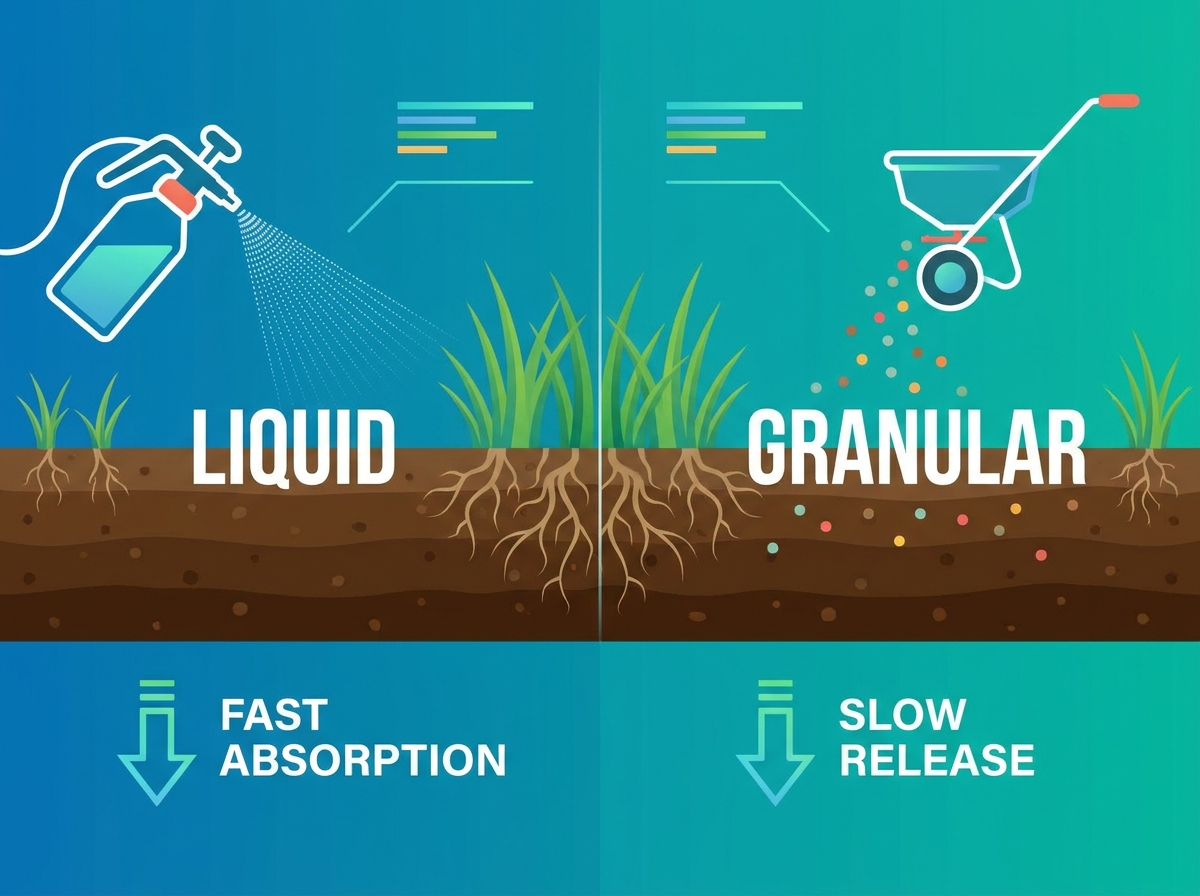
Absorption Speed: Liquid lawn fertilizer provides rapid green-up through direct leaf absorption, while granular fertilizer offers slow-release and long-term root feeding.
Application Equipment: Applying liquid fertilizer requires specific sprayer equipment, whereas granular requires a traditional broadcast or drop spreader.
Precision and Uniformity: Sprayers offer a highly uniform application and easily combine with weed control. However, they require careful calibration to avoid lawn burn.
Best Use Cases: Liquid is ideal for quick nutrient corrections and mid-season boosts. In contrast, granular is best for establishing foundational soil health in early spring and late fall.
Current Industry Trends in Turf Management
Recent market analysis reveals a massive shift in residential lawn care. Consumers are rapidly moving away from traditional manual broadcasting. Instead, there is a growing preference for prosumer-grade liquid application tools. This transition mirrors broader agricultural trends emphasizing precision nutrient management. Homeowners now prioritize targeted foliar treatments. These fast-acting solutions drastically minimize chemical waste and environmental runoff. Consequently, demand for sophisticated battery-operated spraying systems has surged, bridging the gap between commercial turf management and DIY yard care.
The Basics: Understanding Liquid vs Granular Lawn Fertilizer
When evaluating these two distinct nutrient delivery systems, look at the agronomic science. How does grass actually absorb its food? Both formats deliver essential macronutrients like nitrogen, phosphorus, and potassium. Yet, their delivery mechanisms and timelines differ significantly. Understanding these principles helps formulate an objective turf management strategy.
The Mechanics of Liquid Lawn Fertilizer
Liquid fertilizers are highly concentrated water-soluble solutions. You apply them directly to grass blades and the surrounding soil surface. The nutrients remain suspended in water. Thus, they become immediately available for plant uptake without requiring physical breakdown.
This rapid process relies on foliar feeding. The liquid enters the plant through stomata. These microscopic pores sit on the grass blade surface. Nutrients completely bypass the complex biological breakdown of the root system. Consequently, foliar absorption triggers almost immediate nutrient uptake. Agricultural extension studies confirm liquid applications correct severe deficiencies like iron chlorosis in mere days. However, the plant consumes these readily available nutrients rapidly, making the sustained feeding period relatively short.
The Mechanics of Granular Lawn Fertilizer
In contrast, granular fertilizer consists of dry solid pellets. Manufacturers formulate these with specific nutrient ratios. Before grass utilizes these vital nutrients, the physical pellets require breakdown. Irrigation, natural rainfall, and soil microbes drive this process.
The defining characteristic here is controlled-release nitrogen. Manufacturers coat granules in sulfur or advanced polymer resins. These coatings scientifically dictate the exact dissolution rate into the soil profile. This slow-release mechanism provides a steady trickle of food to the roots over several weeks. Specifically, it builds foundational soil health and encourages deep root development. It also minimizes the sudden flush of unruly top-growth often following fast-acting liquid applications.
Excellent. Can mix with herbicides and micronutrients
None. Requires separate passes for different dry products
Evaluating the Pros and Cons
For homeowners and turf professionals seeking absolute precision, liquid fertilizers offer undeniable advantages. However, the rapid nature of foliar feeding introduces specific environmental risks requiring deliberate management.
The Advantages of Going Liquid
Foliar absorption delivers visible green-up and vigorous growth within 24 to 72 hours. This makes liquid formulas highly effective for quick cosmetic corrections. They work perfectly before hosting outdoor events or reviving heavily stressed turf. Moreover, you can easily tank-mix liquid formulas with other lawn care products. Blending pre-emergent herbicides or liquid aeration solutions allows for a highly efficient one-pass application. This strategy saves significant manual labor. When properly agitated, every drop contains the exact guaranteed nutrient analysis. This ensures perfectly even distribution across the lawn.
The Disadvantages of Liquids
Immediate availability means rapid consumption. To maintain consistent color, liquid fertilizers require more frequent applications. You might need to spray every two to four weeks. Additionally, liquid fertilizers carry a higher salt index. Mixing the solution at an incorrect ratio causes issues. Spraying during the scorching heat of a summer afternoon rapidly draws moisture out of the grass blades. Landscaping professionals refer to this severe chemical burn as fertilizer burn.
The Advantages of Granular Formulas
The primary benefit of granular fertilizer lies in its impressive longevity. A dense and springy lawn in early May often results from a well-timed slow-release granular application in early spring. High-quality formulas feed a lawn consistently for four to eight weeks. This significantly reduces the total number of seasonal applications. Granular products are generally safer for novice users. The slow release minimizes the risk of chemically burning the grass. Furthermore, dry granules boast an incredibly long shelf life in a cool garage environment.
The Disadvantages of Granulars
Despite these benefits, granular fertilizer remains virtually useless until adequately watered in. Applying during an extended drought without reliable irrigation leaves the pellets sitting inert on the soil surface. Conversely, torrential rain immediately after application washes granules away before they break down. Standard broadcast spreaders can inadvertently throw pellets onto driveways and sidewalks. This wastes expensive product and leads to unwanted environmental runoff.
The Sprayer Guide: Equipment Selection for Liquid Applications
The application equipment dictates the success of your entire fertilization program. Granular application relies on straightforward mechanical spreaders. Mastering liquid fertilization requires a deeper technical understanding of pump technology, pressure calibration, and nozzle selection. As a fluid dynamics principle, consistent pressure equals consistent coverage.
Choosing the Right Sprayer for Liquid Lawn Fertilizer
Selecting the appropriate sprayer depends on your property size and desired precision. Let us break down the engineering realities of each option.
Hose-End Sprayers: Best suited for small urban lawns under 5,000 square feet. They attach directly to a standard garden hose. The system utilizes home water pressure to siphon and dilute the liquid concentrate. While undeniably convenient, they offer the lowest precision. Natural water pressure fluctuations alter the dilution rate, leading to inconsistent application.
Battery-Operated Backpack Sprayers: This is the sweet spot for medium to large suburban lawns ranging from 5,000 to 15,000 square feet. From an engineering standpoint, manual pump sprayers suffer from pressure drop-off as the tank empties. Battery-powered models maintain a constant pressure. For instance, high-quality units feature 12V diaphragm pumps delivering a steady 70 PSI. This ensures a perfectly consistent spray pattern and uniform droplet size. Look for models equipped with Viton seals to prevent chemical corrosion. They are absolutely perfect for spot treatments or covering an entire yard with granular control over the application rate. You can find professional-grade sprayer equipment that meets these exact specifications to elevate your lawn care routine.
Tow-Behind and ATV Sprayers: For sprawling rural acreage or commercial applications, tow-behind sprayers are the gold standard. Attached directly to a riding mower, these robust units feature large tanks holding upwards of 40 gallons. They utilize boom nozzles covering wide swaths of turf in a single pass. They require careful initial calibration regarding driving speed and pump pressure. However, they offer unmatched efficiency for large-scale liquid fertilization.
Spreaders for Granular Fertilizer
Granular application requires either a broadcast or drop spreader. Broadcast spreaders use a rapidly spinning impeller to throw fertilizer in a wide arc. They are incredibly fast for large open areas. Drop spreaders drop pellets straight down between the wheels. The process is slower but offers exact precision. This makes them ideal for navigating around delicate flower beds where you cannot afford errant pellets.
Can You Melt Granular Fertilizer to Use in a Sprayer?
DIY enthusiasts frequently ask if they can dissolve cheaper granular fertilizer in water. Agronomically and mechanically speaking, this practice is highly discouraged. Standard granular fertilizers contain heavy binders and physical fillers. They utilize slow-release coatings like sulfur or polymer that absolutely do not dissolve in water. Attempting to melt these results in a thick sludgy suspension. This sludge will quickly clog inline filters, ruin expensive brass nozzles, and destroy internal pump mechanisms. Always purchase dedicated liquid concentrates or purely water-soluble powders designed specifically for foliar feeding.
Application Showdown: Which is Easier to Apply?
Beyond the underlying science, the logistical process of applying fertilizer plays a major role in decision-making. Both methods have rigid requirements regarding weather conditions and post-application cleanup.
Weather and Timing Considerations
Liquid applications are highly sensitive to wind and temperature. Spraying on a breezy day leads to chemical drift. The fine mist blows onto non-target areas like prized vegetable gardens or neighboring properties. Additionally, never apply liquids when ambient temperatures exceed 85 degrees Fahrenheit. Rapid water evaporation in high heat leaves behind highly concentrated salts that severely scorch grass blades.
In contrast, granular applications are less affected by wind. However, they depend heavily on immediate moisture. You must meticulously time your granular application just before a light soaking rain. Alternatively, be fully prepared to run your sprinkler system immediately afterward. This activates the microbial breakdown process and prevents dry pellets from burning the soil surface.
Prep and Clean-Up
Preparing a sprayer involves calculating precise square footage and accurately measuring chemical concentrates. You must mix the solution with water and ensure proper tank agitation. After completion, sprayers require meticulous flushing. You must triple-rinse the tank and run clean water through the hoses. Proper disposal of the rinsate prevents residual chemicals from corroding internal pump components.
Granular preparation is as simple as tearing open a bag and pouring dry pellets into the hopper. Cleanup involves pouring unused product back into the bag and sweeping stray pellets off sidewalks. Generally speaking, granular application requires significantly less meticulous cleanup.
Cost, Efficiency, and Environmental Impact
Evaluating the true cost of lawn care goes far beyond the retail price tag. Homeowners must consider application frequency and the ecological footprint of their landscape practices.
Upfront Costs vs. Long-Term Value
On a strict cost-per-square-foot basis, granular fertilizer purchased in heavy bulk bags is cheaper upfront. It slowly feeds the lawn for up to two months, keeping the total seasonal cost low. Liquid fertilizer carries a higher upfront cost per individual application. However, its long-term value increases significantly when factoring in operational efficiency. Because liquids can be safely tank-mixed, you can combine fertilizer, pre-emergent herbicide, and iron supplements into one powerful application. This strategic approach saves hours of grueling manual labor.
Runoff and Environmental Safety
Environmental stewardship is a non-negotiable component of modern turf management. When evaluating liquid versus granular options for ecological safety, liquid formulas present a remarkably low risk of environmental runoff when applied correctly. The plant foliage absorbs the nutrients within mere hours. They are far less likely to wash away during unexpected heavy rainstorms.
Granular fertilizers pose a significantly higher risk to local watersheds if mismanaged. Pellets accidentally broadcast onto paved streets will never break down. The next rainstorm washes these highly concentrated nutrients directly into municipal storm drains. This leads to harmful toxic algae blooms in local lakes. Sweeping up excess granules from hardscaping is a mandatory practice for environmentally responsible lawn care.
How to Choose the Right Fertilizer for Your Lawn
There is no universal best option applying to every single yard. The ideal choice depends entirely on your current soil health, the specific time of year, and your aesthetic goals. Use the following analytical framework to guide your final decision.
Soil Testing and Nutrient Deficiencies
Before investing heavily in any fertilizer program, conduct a professional soil test. If laboratory results reveal a severe micronutrient deficiency, liquid fertilizer is undeniably the superior choice. Foliar feeding bypasses complex soil chemistry locking up vital nutrients. It delivers fast and targeted correction right to the plant. Conversely, if the soil test shows a general lack of organic matter, a slow-release granular product is much better suited to gradually rebuild the soil profile.
Local Climate and Seasonality
During the cooler shoulder seasons of early spring and late fall, the primary agronomic goal is deep root development. Granular fertilizers are highly recommended during these critical times. The slow-release nitrogen builds a robust root foundation without forcing excessive weak top-growth. Mid-summer introduces a different challenge. When turf suffers under intense heat stress, pushing aggressive growth with heavy granular nitrogen proves disastrous. Spoon-feeding the lawn with highly diluted low-dose liquid applications maintains vibrant color without over-taxing the grass.
Boosting Curb Appeal and Property Value
Lawn health is directly tied to real estate value. If you are actively preparing to host an important outdoor event or listing your home for sale, liquid fertilizer is the definitive strategic choice. The rapid foliar uptake provides a stunning cosmetic surge of deep green color. It works in a fraction of the time it takes for granular products to activate. However, if you seek a low-maintenance routine, granular remains the most practical reliable foundation.
Conclusion
Ultimately, choosing the right nutrient delivery system depends on the unique demands of your landscape. Liquid formulas deliver incredibly fast results through direct leaf absorption. They are perfect for quick aesthetic turnarounds and precise nutrient corrections. On the other hand, granular options provide steady long-lasting root nutrition that slowly builds foundational soil health.
For most dedicated homeowners, a strategic hybrid approach yields the healthiest grass possible. Utilizing granular feeds for seasonal baselines while keeping a reliable battery-operated backpack sprayer on hand for liquid micro-adjustments ensures your property looks immaculate year-round. Always test your soil before applying chemical treatments.
If you are ready to upgrade your liquid application game and achieve professional-level precision, investing in the right hardware is crucial. Explore high-performance and durable agricultural sprayers designed to handle everything from delicate foliar feeding to broad-acre weed control. This ensures every drop of your fertilizer is applied with maximum efficiency.
FAQ (Frequently Asked Questions)
What is better: liquid or granular lawn fertilizer?
Neither option is universally superior. Your choice depends heavily on specific agronomic goals and available time. Liquid is better for fast leaf absorption and precise application rates. Granular is better for long-lasting slow-release soil feeding, requiring much less frequent application throughout the busy growing season.
How long does it take for liquid fertilizer to work compared to granular?
Liquid fertilizer provides exceptionally fast visual results. You often see dramatic color changes in as little as 24 to 48 hours because foliar absorption allows nutrients to enter the plant immediately. Granular fertilizer operates on a much slower timeline. It typically takes one to two full weeks to break down. Soil microbes and water must dissolve the physical pellets before the root system can absorb the released nutrients.
Is liquid fertilizer safer for pets and kids?
Safety depends entirely on proper application and allowing adequate drying time. Liquid fertilizer is generally considered safe once it is completely dry. This usually takes a few hours depending on local humidity levels. Once dry, the nutrients are safely locked inside the grass blades. Granular fertilizer presents a slightly longer hazard period. Visible pellets remain on the soil surface until fully dissolved. Always water in granular treatments thoroughly to mitigate any ingestion risks.
Can I use both liquid and granular fertilizer on my lawn?
Yes, many experienced turf professionals utilize a strategic hybrid approach. This maximizes the unique benefits of both delivery methods. However, you must calculate your total nitrogen input very carefully. Avoid applying both products at the exact same time. Stacking heavy applications easily causes severe nitrogen burn. Space your treatments out according to specific product labels.
Does liquid fertilizer wash away in the rain?
Heavy unexpected rain immediately after an application can indeed wash away liquid formulas before absorption. Always allow at least 24 hours of clear dry weather. This gives grass leaves ample time for proper foliar absorption. Once fully absorbed, the nutrients cannot wash away. Conversely, granular fertilizer actually requires rain or irrigation to activate properly.
Can I mix granular fertilizer with water to make liquid?
Standard granular fertilizers are absolutely not designed for water suspension. They contain insoluble binders and heavy fillers that will immediately clog delicate sprayer mechanisms. You should only use specifically labeled water-soluble granular products for spraying. Purchasing dedicated liquid fertilizer is always the much safer and more reliable route.
What is the best time of day to apply liquid fertilizer?
The optimal time to apply liquid fertilizer is early in the morning or late in the afternoon. During these cooler hours, the grass stomata are fully open, maximizing foliar absorption. Applying during the midday heat accelerates water evaporation. This leaves concentrated fertilizer salts on the blades, which drastically increases the risk of chemical turf burn.
Can I apply liquid fertilizer to wet grass?
It is highly recommended to apply liquid fertilizer to dry grass. If the grass blades are already saturated with morning dew or recent rain, the additional liquid fertilizer solution will likely bead up and roll off the foliage into the soil. This completely defeats the purpose of rapid foliar feeding and wastes your expensive chemical concentrate.
Shixia Holding Co., Ltd. was establishes in 1978, that has more than 1,300 employees and more than 500 sets of various injection molding machines, blow molding machines and other advanced equipment.