Views: 0 Author: Site Editor Publish Time: 2026-01-16 Origin: Site


Green and precision agriculture are mainstream. Growers now want sprayers that deliver precise spraying, effective pest control and minimal pollution — not just basic pesticide application. As a pro sprayer manufacturer, SeeSa that precision tech boosts pesticide use efficiency, crop yields, and profits. This guide shares actionable green farming solutions.
In traditional operations, "flood-style" spraying is common. This method leads to uneven droplet size and uncontrolled spraying range, resulting in serious pesticide waste.
This not only increases farming costs but also may cause soil pollution, water eutrophication, and even crop phytotoxicity. For large-scale growers and family farm operators, precision spraying offers three core values:
• Cost Reduction & Efficiency Improvement: Precisely controlling the spraying amount and range can increase pesticide utilization rate by more than 30%, significantly reducing pesticide purchase costs, decreasing re-spray frequency, and improving operation efficiency.
• Quality Enhancement & Crop Protection: Avoid phytotoxicity caused by large droplets and drift loss caused by small droplets, ensuring uniform coverage of the target area with pesticide solution, improving pest and disease control effects, and guaranteeing crop quality.
• Environmental Compliance: Reduce pesticide residues and emissions, comply with the global "pesticide reduction" initiative, lower compliance risks, and facilitate green agricultural product certification.
The key lies in three core technologies: droplet control, targeted positioning, and variable rate spraying.
1. Droplet Control: Choose the Right Particle Size for Effective Pest Control
Droplet size in agricultural sprayers directly influences pesticide adhesion, penetration, and drift risk. For optimal results, pick agricultural sprayers suited to different crops and pests, and match them with corresponding droplet specifications.
Droplet Type | Particle Size Range (μm) | Matching Nozzle | Applicable Scenarios | Core Advantages |
Fine Droplets | 50-150 | Conical Fine Mist Nozzle | Greenhouse vegetables, seedling crops, aphid control | Uniform coverage, strong adhesion, low dosage |
Medium Droplets | 150-300 | Fan Standard Nozzle | Field crops (corn, wheat), conventional disease control | Balanced coverage and penetration, stable efficacy |
Coarse Droplets | 300-500 | Adjustable Coarse Mist Nozzle | Tall fruit trees, high-stalk crops, underground pest control, foliar fertilization | Strong penetration, low drift, suitable for complex crop canopies |
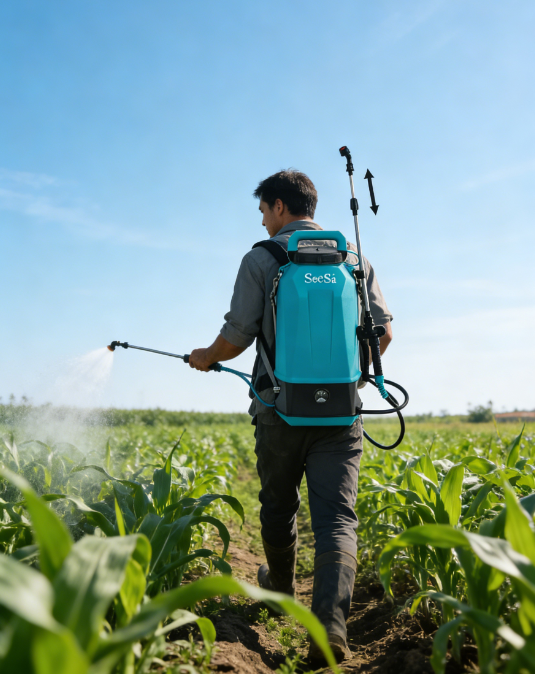
Supplementary Tips: Electric and motorized sprayers can precisely adjust pressure via knobs; manual sprayers need to control pressing frequency to avoid uneven droplets caused by pressure fluctuations.It is recommended to equip an entry-level droplet size measuring instrument for regular calibration of spraying effects.
Practical Application Case: A greenhouse vegetable grower chose a conical fine mist nozzle (50-150 μm droplets) to control aphids, adjusted the electric sprayer pressure to 1.5 bar, and sprayed uniformly at a distance of 30 cm between the nozzle and vegetable seedlings. Compared with traditional extensive spraying, pesticide dosage was reduced by 25%, aphid control rate was increased to 92%, and there was no soil pollution caused by pesticide drift.
2. Targeted Positioning: Precisely Aim at Pests & Diseases to Reduce Pesticide Waste
The core of targeted positioning is to reduce "non-target spraying", concentrate pesticide solution on pest and disease-affected areas, and avoid waste and pollution. Here are 4 key implementation methods:
• Adjust Nozzle Angle: Match the angle according to crop morphology. When spraying row-sown crops (such as wheat), adjust to 45° to aim at the rows; when spraying fruit trees, use a wide-angle nozzle to spray from the inside out to ensure coverage of branches and leaf backs.
• Install Directional Cover: For dense crops (such as greenhouse vegetables), install a directional cover to limit droplet diffusion and avoid spraying on adjacent crops or soil.
• Control Spraying Distance: Keep the nozzle 30-50 cm away from the target area. Too close is likely to cause pesticide accumulation and phytotoxicity; too far will lead to severe droplet drift.
• Adapt to Growth Stages: Adopt low-position and low-volume spraying at the seedling stage, medium-position and uniform spraying at the mature stage, and high-position and precise spraying before harvest.
3. Variable Rate Spraying: Adjust on Demand, Reject Uniform Spraying
Variable rate spraying means adjusting the spraying amount according to the severity of pests and diseases and crop growth conditions in different plots. Ordinary sprayers can achieve this through the following simple methods:
• Sectional Marking: Survey the plot in advance, divide areas according to the severity of pests and diseases, and make scale marks on the pesticide tank. Appropriately increase the spraying amount in severely affected areas (not exceeding the upper limit of the manual) and reduce the dosage in slightly affected areas.
• Flow Regulation: Choose electric/motorized sprayers with flow control, and control the spraying amount per hectare via knobs. For example, conventional field crops require 225-450 L/ha; when pests and diseases are severe, it can be adjusted to 450-675 L/ha (matching corresponding nozzles is required).
• Match with Simple Intelligent Tools: Large-scale growers can use basic field monitoring equipment (such as insect traps, soil moisture meters) to determine spraying timing and dosage, avoiding blind spraying.
Green farming not only requires precision spraying but also comprehensive environmental control throughout the spraying operation. Every link from pesticide selection, spraying operation to waste liquid treatment can reduce pollution and lower risks.
1. Front-End Control: Scientific Pesticide Selection to Reduce Pollution at the Source
• Prioritize biological pesticides and low-toxicity, low-residue pesticides; avoid using highly toxic and difficult-to-degrade pesticides to reduce soil and water pollution.
• Use eco-friendly adjuvants (such as silicone adjuvants) to improve adhesion and penetration, reduce pesticide dosage, and avoid harm to crops and the environment.
• Strictly follow the pesticide manual for proportioning; do not arbitrarily increase the concentration to prevent excessive residues and emissions.
2. Process Control: Standardized Operation to Prevent Pesticide Leakage
• Choose the Right Operation Time: Avoid spraying on windy days (wind speed exceeding 3 m/s), high-temperature days (temperature exceeding 30℃), or rainy days. On high-temperature days, spray in the early morning or evening to improve efficacy and reduce volatilization.
• Check Sealing Performance: Before operation, inspect the pesticide tank, pipelines, nozzles, and seals to ensure no leakage and avoid soil pollution caused by pesticide dripping.
• Avoid Cross-Contamination: Thoroughly clean the sprayer when changing pesticides. Rinse with clean water more than 3 times first; use corresponding neutralizers to clean acidic/alkaline pesticides, and finally rinse with clean water again.
3. Back-End Treatment: Proper Disposal of Waste, No Random Discarding
• Waste Liquid Treatment: Do not randomly dump leftover pesticide solution. It can be diluted for supplementary spraying of corresponding pests and diseases or sent to designated locations for centralized treatment.
• Packaging Treatment: Rinse pesticide bottles/bags more than 3 times, collect them and hand them over to official recycling points; do not randomly discard or incinerate.
• Cleaning Wastewater: Guide the wastewater from cleaning the sprayer into farmland drainage ditches or treatment pools, avoiding direct flow into rivers, ponds, and other water bodies.
1. How to choose the right agricultural sprayer for precision spraying?
It needs to be matched according to the planting scale and terrain: for small areas (less than 0.3 hectares), manual sprayers with adjustable nozzles are cost-effective; for medium-scale farms (0.3-3 hectares), electric sprayers with digital pressure and flow control are recommended for stable effects; for large areas or complex terrain (more than 3 hectares), motorized sprayers with high-pressure wide-angle nozzles are suggested to improve operation efficiency. Focus on core functions such as pressure adjustment and nozzle compatibility to ensure it meets the droplet control and targeted positioning requirements of precision spraying.
2. Will precision spraying increase farming costs?
No, it will instead reduce long-term costs. Precision spraying can increase pesticide utilization rate by more than 30%, reducing pesticide purchase expenses; ordinary sprayers only need low-cost upgrades (such as adjustable nozzles of $1.5-$4.5, directional covers of $3-$8) to achieve basic precision spraying, without the need for expensive high-end equipment; reduced re-spray frequency also saves labor costs.
3. How much can precision spraying with agricultural sprayers improve pesticide utilization rate?
Precision spraying with agricultural sprayers can increase pesticide utilization rate by more than 30%. This is because it relies on core technologies such as droplet control and targeted positioning of agricultural sprayers, avoiding pesticide waste caused by traditional "flood-style" spraying. For example, electric sprayers with flow control can further stabilize the utilization rate by precisely adjusting the dosage per hectare; even ordinary manual sprayers can effectively improve pesticide utilization rate after nozzle optimization and standardized operations.
Precision spraying is not exclusive to large-scale growers; all growers can achieve it. Through reasonable selection, accessory upgrades, and standardized operations, the goals of precision spraying, reduced dosage, increased efficiency, and green environmental protection can be achieved. From droplet control to waste liquid treatment, refined management of every link is the key to improving farming profits and practicing green agriculture.SeeSa specializes in the R&D and production of agricultural sprayers. Its manual, electric, and motorized sprayers are all suitable for precision spraying needs and can provide customized solutions for different farming scenarios. To learn more about precision spraying equipment and technologies suitable for your needs, welcome to visit our official website or contact us, and let professional equipment and technologies empower your green farming.