Imagine upgrading your home gardening, cleaning, or small-scale farming with a tool that's precise, effortless, and cost-effective. What is a pressure sprayer, and why is it a must-have for daily and agricultural tasks? Powered by pre-stored air pressure, this portable device delivers stable pressure and uniform misting—solving the low-pressure frustration of ordinary manual trigger sprayers, no batteries or fuel required. It's versatile enough for home cleaning, plant care, small farm work,and sanitation, balancing precision and economy perfectly. In this guide, we'll break down its core benefits, how to use it, maintenance tips, and purchasing strategies to help you find the ideal model for your needs.
What Is a Pressure Sprayer?
A pressure sprayer is a device that stores air in a sealed tank through manual pressurization. It uses the pressure difference between the internal tank pressure and the external environment to push the liquid in the tank through the nozzle for atomization and spraying. Its core principle is similar to a pressure tank,with three key steps:
Liquid Filling: Pour the solution (water + chemicals/cleaners/fertilizers, etc.) into the liquid storage tank, leaving about 20% of the space for air.
Pressurization: Repeatedly press the manual pump rod to compress external air into the tank, forming a stable pressure (usually 1-8 bar).
Spraying: When the trigger is pressed, the internal air pressure continuously pushes the liquid along the hose to the nozzle. Through the special structure of the nozzle, the liquid is dispersed into fine mist, direct jet, and other forms, realizing continuous spraying without the need for constant pumping.
Compared with ordinary manual trigger sprayers (which require repeated trigger pressing for pumping) and battery-powered sprayers (which rely on electricity), its core advantages are: stable pressure → uniform misting, one-time pressurization → continuous use, and simple structure → easy maintenance.
Main Types of Pressure Sprayers: Classified by Scenarios
Based on capacity, structure, and application scenarios, pressure sprayers can be divided into 3 types. Their core parameters and adapted needs are as follows:
Type | Capacity Range | Core Structural Features | Pressure level | Application Scenarios | Core Advantages | Limitations |
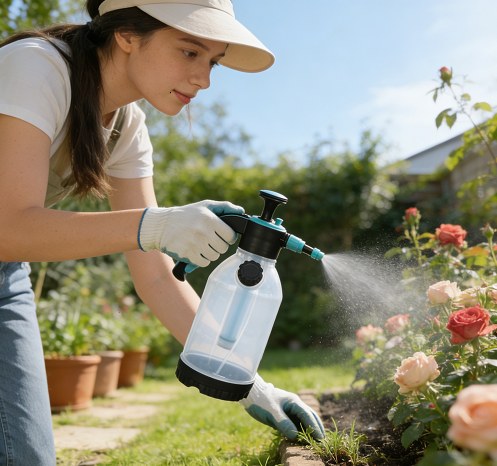
Small Handheld Pressure Sprayer | 0.5-3L | Integrally formed pressure storage tank, short spray rod, manual pressure pump | Low (1-3 bar) | Home cleaning, indoor plant watering, small-scale disinfection | Extremely portable, easy to operate, lightweight (≤2kg when full) | Small capacity, only suitable for micro-tasks, limited pressure |
Medium-Sized Pump Pressure Sprayer | 5-10L | Independent pressure storage tank , long spray rod (60-80cm), piston pressure pump, with pressure relief valve | Medium (3-6 bar) | Small garden weeding/fertilizing, seedling irrigation, small farm local spraying | Balanced capacity and pressure, long spray distance (1.5-3 meters), continuous spraying for 30-60 seconds per pressurization | Requires manual pressurization, slightly laborious for long-time operations |
Large Backpack Pressure Sprayer | 10-20L | Backpack frame + padded shoulder straps, large-capacity pressure storage tank, high-pressure piston pump, multi-nozzle adaptation | High (6-8 bar) | Large garden/hedge maintenance, orchard/vegetable plot care, public area disinfection
| Large capacity reduces refilling times, high pressure adapts to long-distance/large-area spraying, evenly distributed weight | Heavy self-weight + liquid weight (about 15-25kg when full), requires certain physical strength |
Supplementary Notes:
• Spray Modes: All types support adjustable nozzles, which can switch between fine mist (suitable for plant care), conical spray (suitable for weeding), and direct jet (suitable for cleaning/long-distance spraying).
• Material Differences: Household models are mostly HDPE plastic tanks (lightweight and corrosion-resistant), while professional-grade models can choose metal tanks (stronger pressure resistance but slightly heavier).
Core Advantages of Pressure Sprayers: Why Choose Them?
Uniform and Precise Misting: The pre-stored air pressure is stable, and the sprayed droplets are consistent in size, avoiding the intermittent strength problem of ordinary manual sprayers. It is especially suitable for scenarios requiring high mist uniformity (e.g., seedling fertilization, foliar spraying).
Effortless Operation and Higher Efficiency: Only 3-5 manual pressurizations are needed in the early stage, and then the trigger can be pressed for continuous spraying without constant pumping. It saves more than 50% of physical strength compared with ordinary manual trigger sprayers, making it suitable for medium-area operations.
Simple Structure and Low Maintenance Cost: No complex components such as batteries and motors, resulting in fewer failure points. Only regular cleaning of nozzles and seals is required, and the service life can reach 3-5 years.
Multifunctional Adaptation and Wide Scenarios: Compatible with various solutions such as clean water, cleaners, liquid fertilizers, and mild pesticides. It integrates multiple uses such as cleaning, maintenance, and disinfection, with outstanding cost performance.
Safe, Reliable, and No Additional Consumption: No need for charging or refueling, avoiding the risk of battery leakage and fuel leakage; Equipped with a pressure relief valve to prevent excessive pressure in the tank, making it safer to use.
Application Scenarios: When to Choose a Pressure Sprayer
Daily Home Scenarios
Cleaning and Disinfection: Can be used for disinfecting desktops, floors, bathrooms, and other areas. The fine mist can evenly cover the surface, saving liquid and leaving no residue.
Indoor Plant Care: Watering and moisturizing potted plants such as epipremnum aureum and succulents, or spraying foliar fertilizers. The fine mist will not damage the leaves.
Home Cleaning: Spraying windows, glass, and furniture with cleaning solutions for more convenient and efficient wiping afterward.
Gardening Scenarios
Small Garden/Balcony Gardening:When using a garden sprayer to apply herbicides, the fine mist can accurately cover the target area to avoid damaging crops; Spraying liquid fertilizers on flowers with it can achieve uniform coverage .
Seedling/Greenhouse Maintenance: When watering delicate seedlings, the fine mist simulates natural rainfall to prevent seedlings from being washed down; It can also adjust the humidity in the greenhouse.
Fruit Tree/Shrub Care: For pest control spraying on low fruit trees and hedges, the medium-pressure model has a spray distance of up to 3 meters, eliminating the need for high-altitude operations.
Light Agricultural Operations
Small Farms/Vegetable Plots: Conduct local pest control and foliar fertilizer application. The 5-10 liter medium-sized model can meet the operation needs of half an acre of land.
Seedling Nursery Cultivation: Moisturizing and disinfecting batch seedlings. The high-pressure model has a wide spray range, which can improve operation efficiency.
Sanitation and Epidemic Prevention Scenarios
Disinfection of Homes/Small Shops: Can be used for small-area environmental disinfection during epidemics. The fine mist has strong penetration and achieves more thorough disinfection.
Pet Environment Cleaning: Compatible with pet-specific disinfectants for disinfecting pet nests and courtyard corners, safe and residue-free.
Core Structure and Key Components of Pressure Sprayers
The performance of a pressure sprayer relies on the collaboration of various components. The core components and their functions are as follows:
•Pressure Storage Tank: The core component used to store solutions and compressed air. The material is mostly HDPE (household models) or stainless steel (professional models). It needs to be pressure-resistant, corrosion-resistant, and not easily deformed. The capacity directly determines the operation time.
•Manual Pressure Pump: Mostly piston pumps (high pressurization efficiency and good energy storage effect), installed on the top or side of the tank. Air compression is achieved through repeated pressing. The sealing performance of the pump directly affects the pressure retention time.
• Pressure Relief Valve: A safety component that automatically releases pressure when the internal pressure of the tank exceeds the rated value to avoid tank explosion. It is necessary to regularly check its flexibility.
• Nozzle: Controls the spray form. The adjustable nozzle (twist to switch between fine mist/direct jet) is the most commonly used. Professional models can replace fan-shaped and conical nozzles. The material is preferably brass or corrosion-resistant plastic (suitable for chemicals).
• Hose and Trigger: The hose needs to be soft and wear-resistant, with a length of usually 30-80cm (long hoses are suitable for long-distance operations); The trigger has a locking function to achieve continuous spraying and reduce finger fatigue.
• Seals (O-rings/Gaskets): Located at the connections of the pump body, nozzle, and tank mouth to prevent pressure leakage. The material is preferably Viton (resistant to chemical corrosion, suitable for pesticides/cleaners).
Correct Use of Pressure Sprayers: Steps + Safety Tips
Operation Steps (4 Easy Steps)
Preparation: Check if the pressure storage tank has cracks and if the seals are intact; Adjust the shoulder straps (for backpack models) or holding position to ensure comfort; Open the tank cover and clean the filter inside the tank (to prevent impurities from clogging the nozzle).
Solution Mixing: Mix water and chemicals (pesticides/fertilizers/cleaners) in proportion, pour into the pressure storage tank with a funnel, and the liquid level shall not exceed 80% of the tank capacity (reserve space for air compression); Tighten the tank cover to ensure a tight seal.
Pressurization and Spraying: Repeatedly press the pressure pump until obvious resistance is felt (pressure reaches 1.5-4 bar, adjusted according to the task); Hold the spray rod, aim at the target area, and press the trigger to spray. For continuous spraying, lock the trigger; If the pressure drops during spraying, supplement 1-2 pressurizations.
Post-Operation Treatment: Release the trigger and open the pressure relief valve to release residual pressure; Pour out the remaining solution in the tank and rinse the tank with clean water 2-3 times (to avoid chemical residue corrosion); Store after drying.
Safety Notes
Wear Protective Equipment: When handling pesticides and cleaners, wear gloves, goggles, and masks to avoid solution contact with the skin and respiratory tract.
Avoid High-Pressure Direct Injection: Do not spray at people, animals, or fragile items. High-pressure direct injection may cause injury or damage.
Choose Windless Weather: When spraying pesticides/herbicides outdoors, avoid strong winds to prevent solution drift, which affects effectiveness or pollutes the environment.
Prohibit Over-Pressurization: Do not exceed the rated pressure resistance level of the tank (usually marked on the tank body) to prevent tank damage.
Chemical Compatibility: Avoid mixing highly acidic and alkaline chemicals. Choose solutions compatible with the tank and seals (refer to the product manual).
Maintenance Tips: Extend Service Life and Maintain Performance
The core of pressure sprayer maintenance is anti-corrosion, anti-leakage, and anti-clogging. Daily maintenance is divided into 3 steps:
Cleaning After Each Use
Rinse the pressure storage tank, hose, and nozzle with clean water. Especially after using pesticides/fertilizers, rinse repeatedly more than 3 times to ensure no chemical residues.
If the nozzle is clogged, clean the aperture with a soft brush (metal tools are prohibited) or soak in warm water for 5 minutes before rinsing to avoid deformation affecting the spray effect.
Regular Component Inspection
Check weekly if the seals (O-rings/gaskets) are aging or cracked. Replace them in time if damaged (it is recommended to keep a spare set of seals).
Check monthly if the pressure relief valve is flexible. Press the pressure relief button to ensure normal pressure release.
If the pressure pump gets stuck, drop 1-2 drops of light oil to lubricate the pump rod for smooth movement.
Proper Storage
Store in a cool, dry, and ventilated place, away from direct sunlight (to avoid aging of the plastic tank) and high-temperature environments.
Ensure the tank is dry and free of residual solution before storage to avoid internal corrosion; Backpack models should be hung or placed flat to avoid tank extrusion.
When not in use for a long time, release all pressure in the tank, disassemble the nozzle and hose, and store them separately to prevent loss.
Purchasing Guide: How to Choose the Right Pressure Sprayer for You
Capacity Matching Scenarios
Home cleaning and indoor plant care: Choose a small handheld model of 0.5-3 liters, which is both portable and space-saving.
Balcony/small garden (10-50㎡): Choose a medium-sized pump pressure model of 5-10 liters, balancing capacity and portability.
Courtyard/small farm (50-200㎡): Choose a backpack model of 10-20 liters to reduce the trouble of frequent refilling.
Pressure Requirements
Fine mist spraying (e.g., seedlings, foliar fertilizers): Choose a low-pressure model (1-3 bar) with delicate droplets that will not damage plants.
Long-distance/large-area spraying (e.g., hedges, vegetable plots): Choose a medium-high pressure model (3-8 bar) with a wide spray range and strong penetration.
Material and Compatibility
Only use clean water/neutral cleaners: Choose an ordinary HDPE plastic tank + rubber seals.
Use pesticides/herbicides/acidic fertilizers: Choose a thickened HDPE tank + Viton seals + brass nozzles (corrosion-resistant).
Ergonomic Design
Handheld models: Choose models with a comfortable grip and labor-saving pump rod.
Backpack models: Choose models with padded adjustable shoulder straps + waist belts (to distribute weight and reduce back pressure).
3 Must-Ask Questions for Suppliers
What is the rated pressure resistance level of the tank? Is it compatible with the chemicals I will use (e.g., pesticides/strong acid cleaners)?
Are spare parts such as seals and nozzles easy to purchase? What is the warranty period?
Does it come with safety components such as a pressure relief valve and filter? Is there a user manual and maintenance guide?
Conclusion
As a practical tool for home cleaning, gardening, agricultural operations, and sanitation and epidemic prevention, the core value of pressure sprayers lies in precision, labor-saving, and durability. Through years of technical accumulation, Shixia Holding Co., Ltd. has further amplified these values: from food-grade materials to composite pressure-resistant tanks, from three-speed adjustable nozzles to dual safety devices.
• For home users, Shixia's small-sized models help you easily handle cleaning and plant care;
• For gardening enthusiasts, Shixia's medium-sized models save time and effort in small garden operations;
• For professional practitioners, Shixia's backpack models can adapt to high-frequency and high-intensity operations.
Finally, a reminder: Regardless of which model you choose, by following correct use + regular maintenance, Shixia Holding Co., Ltd.'s pressure sprayer will become your long-term reliable assistant, helping you achieve the core needs of precise spraying without waste and efficient operation with less effort.
FAQ
Q: What is the difference between a pressure sprayer and an ordinary manual trigger sprayer?
A: Ordinary manual trigger sprayers require repeated trigger pressing for pumping, resulting in unstable pressure and uneven misting; Pressure sprayers only need pre-pressurization for subsequent continuous spraying, with stable pressure, labor-saving operation, higher precision, and are suitable for medium-area operations.
Q: Why does the pressure decrease during spraying?
A: It may be due to seal leakage (check the tank mouth and pump body connections), nozzle clogging (clean the nozzle), or insufficient pressurization (supplement pressurization); If pressure is released frequently, replace the aging seals.
Q: Can pressure sprayers hold flammable liquids such as gasoline and alcohol?
A: Not recommended! The tank and seals of ordinary pressure sprayers do not have explosion-proof functions. Flammable liquids may cause dangers when exposed to pressure or friction. A dedicated explosion-proof sprayer is required.
Q: The backpack pressure sprayer is too heavy when full. Are there any ways to reduce the burden?
A: Choose a model with a waist belt (to distribute part of the weight to the waist); When operating, spray long-distance areas first, then short-distance areas to reduce back-and-forth movement; Fill the tank with liquid according to the operation area to avoid unnecessary burden from full filling.