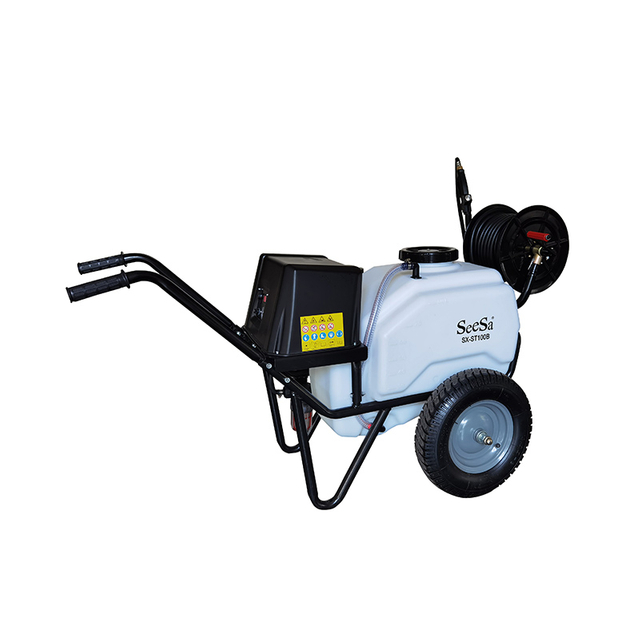

Understanding common faults of a wheelbarrow electric sprayer helps you diagnose issues quickly without waiting for professional repair support. Many pressure, leakage and clogging problems originate from blocked filters, worn seals or battery problems. Good daily care is always better than emergency repairs. Flushing your sprayer after each job and checking key consumable parts will greatly extend the service life of your electric sprayer. When faults cannot be solved with basic troubleshooting, stop operating and use qualified genuine replacement spare parts.

This article introduces wheelbarrow electric sprayers, covering their benefits, application scenarios and buying tips for orchards, greenhouses and livestock sanitisation. A practical FAQ answers common questions about battery runtime, chemical compatibility and routine upkeep. It advises growers to choose equipment based on actual field conditions instead of only chasing larger tank capacity.

Stop spray drift and chemical waste. Master knapsack sprayer pressure, nozzle selection, and droplet size for maximum coverage and precision.

Fix pressure drops and pump cycling in your knapsack electric pressure sprayer. Master internal mechanics to troubleshoot and avoid costly repairs.

Prevent crop damage and chemical waste. Learn how to accurately measure knapsack sprayer nozzle flow rates for precise calibration.

A sprayer can have a full battery and a working pump, yet still deliver poor results. Weak flow, uneven mist, and blocked nozzles often come from contamination inside the spray liquid, not electrical problems. An agriculture sprayer relies on several filtration stages to keep liquid moving smoothly. The filtration path usually includes the tank strainer, pump filter, hose system, nozzle screen, and nozzle opening. Each component handles different particles and protects a different part of the spraying process. In this guide, you will learn how tank strainers, pump filters, and nozzle screens work together. You will also understand how to choose, inspect, and maintain filtration components for reliable electric sprayer performance.

A sprayer can keep running while its actual output changes. Pressure may drop, flow may shift, and droplet quality may become inconsistent. In an agriculture sprayer, battery load refers to the electrical demand created by the pump during operation. The system works through a simple chain: battery power drives the diaphragm pump, which creates pressure and feeds the nozzle. Output depends on flow rate, spray pressure, droplet size, spray pattern, reach, and runtime. Battery condition and nozzle choice must be considered together because changes in nozzle restriction or pressure demand affect pump workload. Understanding these factors helps operators achieve more stable coverage and predictable spraying performance.

One careless product change can affect the next spraying job. The risk may remain even when the tank looks clean. Many farms use one agriculture sprayer for herbicides, pesticides, fertilizers, and foliar treatments. Separate equipment is not always practical. However, chemical residue can stay inside pumps, hoses, filters, valves, and nozzles after the tank is emptied. These hidden residues may injure sensitive crops, affect later treatments, or create deposits that restrict liquid flow. Dedicated sprayers can reduce carryover risks for high-risk products. Shared equipment needs a clear cleaning and product-change procedure. This guide explains how to prevent cross-contamination before, during, and after switching between herbicides, pesticides, and fertilizers.

Pressure is not only about spray strength. Even small pressure changes can alter how droplets form and reach crop surfaces. In an agriculture sprayer, pump output, system pressure, nozzle flow, and liquid breakup work as one connected process. When pressure stays stable, the nozzle can produce a more repeatable droplet spectrum and more consistent crop coverage. When pressure fluctuates, flow rate and droplet size may change during the same spraying pass. Battery-powered sprayers reduce pressure variation from manual pumping, but other causes still remain. Pump cycling, battery condition, blocked filters, nozzle selection, and pressure adjustment can all affect stability. This guide explains how pressure stability affects droplet uniformity and shows where pressure problems usually begin. You will also learn how to recognize unstable spraying and maintain more repeatable nozzle performance.

Two farmers can use the same agriculture sprayer and crop treatment but achieve different results. The difference often comes from spray volume, not the equipment itself. Low-volume and high-volume application refer to the amount of carrier liquid applied to the crop, not tank size. Lower volume can improve efficiency but requires accurate droplet control and coverage. Higher volume can improve wetting and penetration but may increase runoff and waste. In this guide, you will learn how to choose spray volume, configure an agriculture electric sprayer, and calibrate it for more consistent application results.

Stop messy plant misting! Discover how a trigger fine mist sprayer prevents leaf pooling, fungal issues, and floor damage.

Master dip tube specs for trigger sprayers: precise length, 45° cut, bottle fit. Prevent waste, jams, and vacuum sealing.

Stop inconsistent spray & waste. Our guide reveals how precise trigger sprayer engineering ensures uniform fine mist and zero sputtering.

Don’t use a needle! Learn the 15-minute vinegar soak that clears hard water clogs in trigger sprayers and when to replace them for cost-saving maintenance.

Learn how to choose the best agriculture electric sprayer. Compare lithium batteries and diaphragm pumps to maximize efficiency on your farm.

Learn to safely assemble, operate, and maintain your agricultural electric sprayer to optimize crop yields and extend equipment lifespan.

Learn how to choose and use an agriculture knapsack manual sprayer for reliable, low-cost, and precise off-grid crop management.

Find the best agriculture knapsack electric sprayer for your farm. Learn about pump types, battery life, durability, and maintenance tips.

Avoid costly downtime with our guide to agricultural sprayer maintenance, covering pump care, nozzle calibration, and winterization.

Learn to choose, calibrate, and safely run an agriculture ATV sprayer. Master coverage math, tank capacity limits, and optimize farm spraying.
How to Choose the Right Sprayer: Electric vs. Manual Sprayers
When it comes to maintaining your garden or tackling agricultural tasks, having the right sprayer is essential. Sprayers are versatile tools that can be used for a variety of purposes, from applying pesticides and herbicides to watering plants. One of the key decisions you'll need to make when selecting a sprayer is whether to go for an electric sprayer or a manual sprayer.
Electric Sprayers: Harnessing Power and Efficiency
Electric sprayers are powered by electricity, typically through a rechargeable battery. These sprayers offer numerous advantages, making them a popular choice among gardeners and professionals alike.
Ease of Use: Electric sprayers are incredibly easy to operate. With just a press of a button or a trigger, you can start spraying. This feature makes them ideal for individuals who may have difficulty with manual pumping.
Efficiency: Electric sprayers are designed to provide consistent and continuous spraying. Unlike manual sprayers that require pumping to build up pressure, electric sprayers maintain a constant flow of liquid, ensuring even application and saving you time and effort.
Adjustable Pressure: Many electric sprayers come with adjustable pressure settings, allowing you to customize the spray pattern and intensity based on your needs. This versatility makes them suitable for various applications, from light misting to heavy-duty spraying.
Extended Reach: Electric sprayers often come with long hoses or extension wands that allow you to reach high or distant areas without straining yourself. This feature is particularly useful for spraying trees, tall shrubs, or large garden beds.
Versatility: Electric sprayers can be used for a wide range of applications, including spraying fertilizers, herbicides, pesticides, and even cleaning solutions. They are a versatile tool that can adapt to different tasks around your garden or farm.
Manual Sprayers: Simplicity and Portability
While electric sprayers offer convenience and power, manual sprayers have their own set of advantages that make them a viable option for many individuals.
Portability: Manual sprayers are lightweight and portable, making them easy to carry around. They don't require a power source or battery, allowing you to use them in remote areas or locations without electricity.
Cost-Effective: Manual sprayers are generally more affordable than electric sprayers. If you have a small garden or occasional spraying needs, a manual sprayer can be a cost-effective solution that gets the job done without breaking the bank.
Low Maintenance: Manual sprayers have fewer components and don't rely on batteries or motors. This simplicity translates into lower maintenance requirements and reduced chances of malfunctions. With proper care and regular cleaning, a manual sprayer can last for years.
Manual Pressure Control: Unlike electric sprayers with preset pressure settings, manual sprayers allow you to control the pressure by pumping the handle. This feature gives you more control over the spray pattern and intensity, allowing for precise application.
Environmentally Friendly: Manual sprayers don't require electricity or produce emissions, making them an eco-friendly option. If sustainability is a priority for you, a manual sprayer aligns with your environmental values.
Choosing the Right Sprayer for Your Needs
Now that you understand the differences between electric and manual sprayers, it's important to consider your specific needs and requirements before making a decision. Here are some factors to consider:
Size of the Area: If you have a large garden or agricultural field that requires frequent and extensive spraying, an electric sprayer might be the better choice. Its efficiency and extended reach will save you time and energy. However, if you have a small garden or only need occasional spraying, a manual sprayer can suffice.
Type of Application: Consider the type of substances you will be spraying. If you need to apply pesticides, herbicides, or other chemicals that require precise control and even distribution, an electric sprayer with adjustable pressure settings can provide the accuracy you need. On the other hand, if you're primarily spraying water or simple solutions, a manual sprayer can handle the task effectively.
Budget: Consider your budget and the long-term cost implications. Electric sprayers may have a higher upfront cost due to the inclusion of batteries and motors. However, they offer convenience and efficiency. Manual sprayers are generally more affordable, but they require manual effort and may not be as time-efficient for larger spraying tasks.
Types of Electric Sprayers
The electric knapsack sprayer is a portable and versatile sprayer that can be worn on the operator's back. It consists of a tank, a battery-powered pump, a spraying wand, and adjustable nozzles. The ergonomic design allows for comfortable carrying and ease of movement, making it ideal for agricultural, horticultural, and gardening applications. The electric knapsack sprayer provides precise and even spraying, reducing waste and ensuring effective coverage.
Similar to the knapsack sprayer, the electric shoulder sprayer is designed to be carried on the operator's shoulder. It offers the same convenience and mobility, allowing users to move freely while spraying. The electric shoulder sprayer is commonly used in smaller-scale applications, such as home gardens, nurseries, and greenhouses. It provides excellent control and accuracy, making it suitable for targeted spraying and spot treatments.
The electric handheld sprayer is a compact and lightweight option for smaller tasks and areas that require precision spraying. It is equipped with a comfortable handle and a trigger mechanism that allows for easy operation. The handheld sprayer is commonly used for indoor applications, such as disinfection, cleaning, and pest control. It is also popular in automotive detailing and household maintenance.
The electric wheelbarrow sprayer is a highly efficient sprayer designed for larger-scale applications, such as agricultural fields, orchards, and golf courses. It features a large-capacity tank mounted on a wheelbarrow-like frame, making it easy to transport and maneuver. The electric pump provides consistent pressure, ensuring uniform spraying and optimal coverage. The wheelbarrow sprayer is ideal for professionals who need to cover extensive areas quickly and efficiently.
The electric trailed sprayer is a heavy-duty sprayer designed for commercial and industrial applications. It is towed behind a tractor or other vehicle, allowing for efficient spraying of large fields or landscapes. The trailed sprayer typically has a high-capacity tank, multiple spraying booms, and advanced controls for precise application. It is commonly used in agriculture, forestry, and municipal maintenance.
The ATV electric sprayer is specifically designed to be mounted on all-terrain vehicles (ATVs) or utility task vehicles (UTVs). It offers the benefits of mobility and versatility, allowing operators to access hard-to-reach areas with ease. The ATV electric sprayer is commonly used in agriculture, landscaping, and pest control. It provides efficient coverage on uneven or rugged terrains.