|


ST60A
Seesa


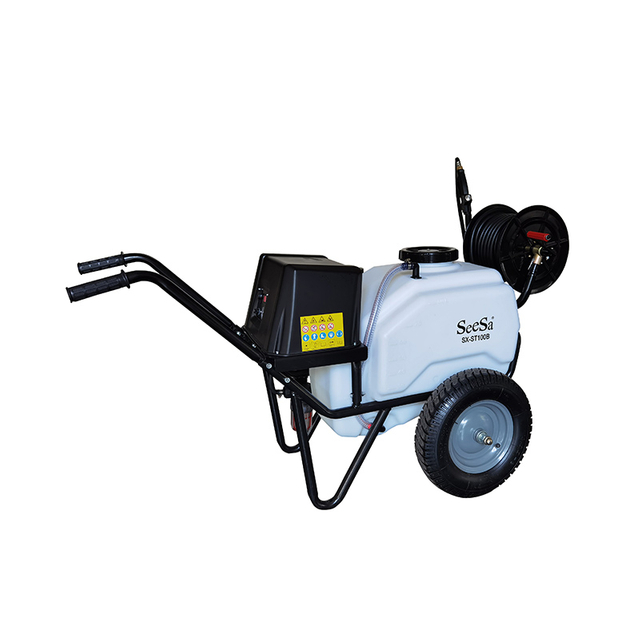
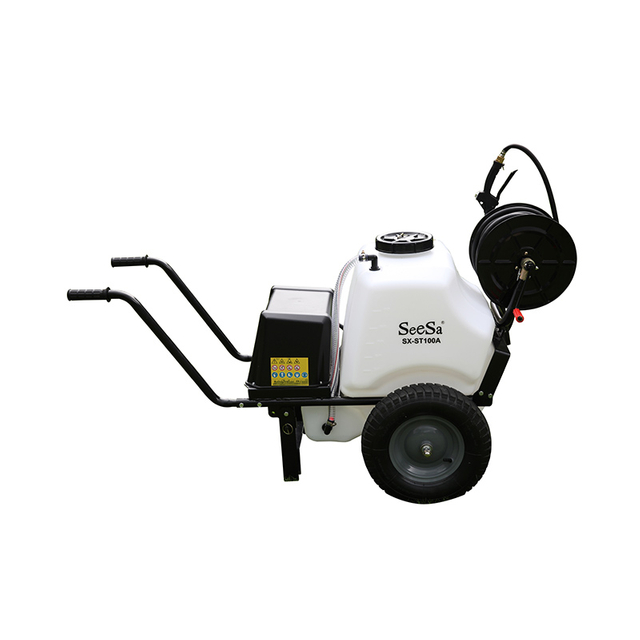
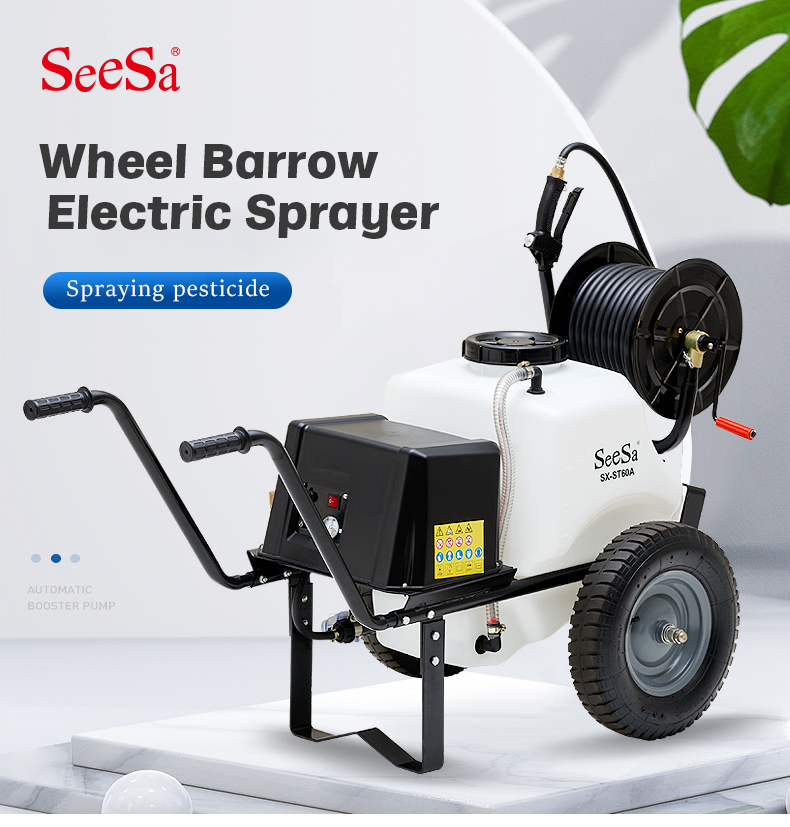
The SX-ST60A combines a large-capacity tank, battery-powered pump and wheeled frame in one mobile spraying system. Its functions are arranged around practical field operation, from moving and filling the unit to adjusting pressure, monitoring liquid level and cleaning after use.
60L spray tank: Provides more working capacity than a conventional knapsack sprayer and helps reduce refill frequency.
12V 38Ah battery: Supplies power for mobile spraying without continuous manual pumping.
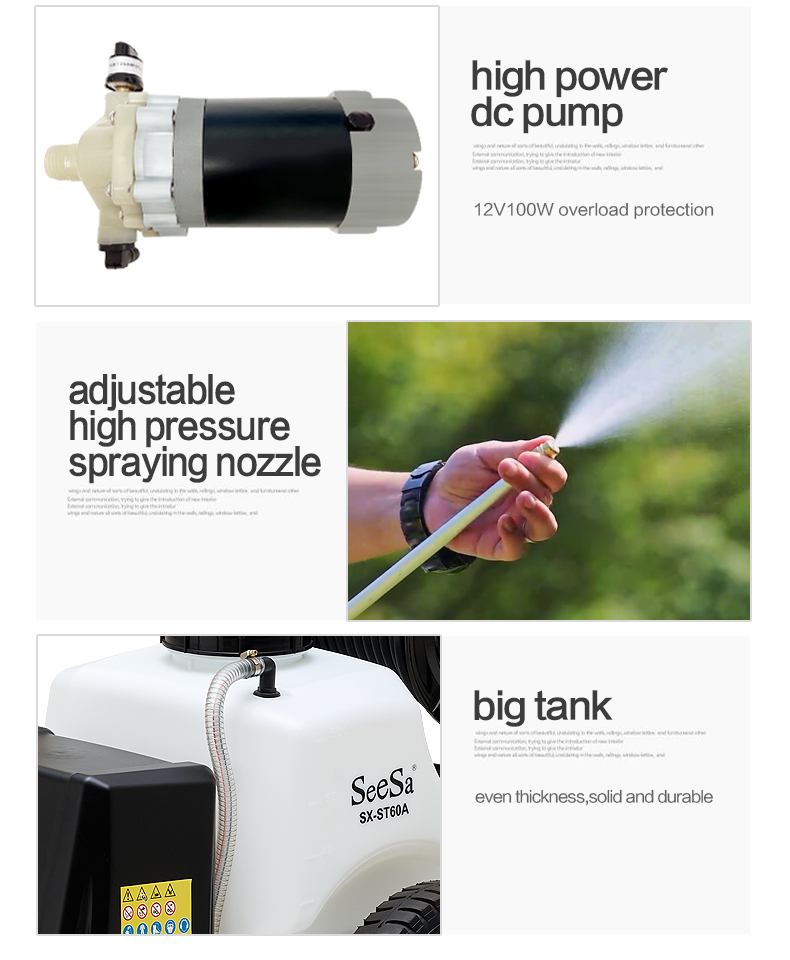
100W diaphragm pump: Delivers a rated pressure of 10 bar for fine mist and directed spraying.
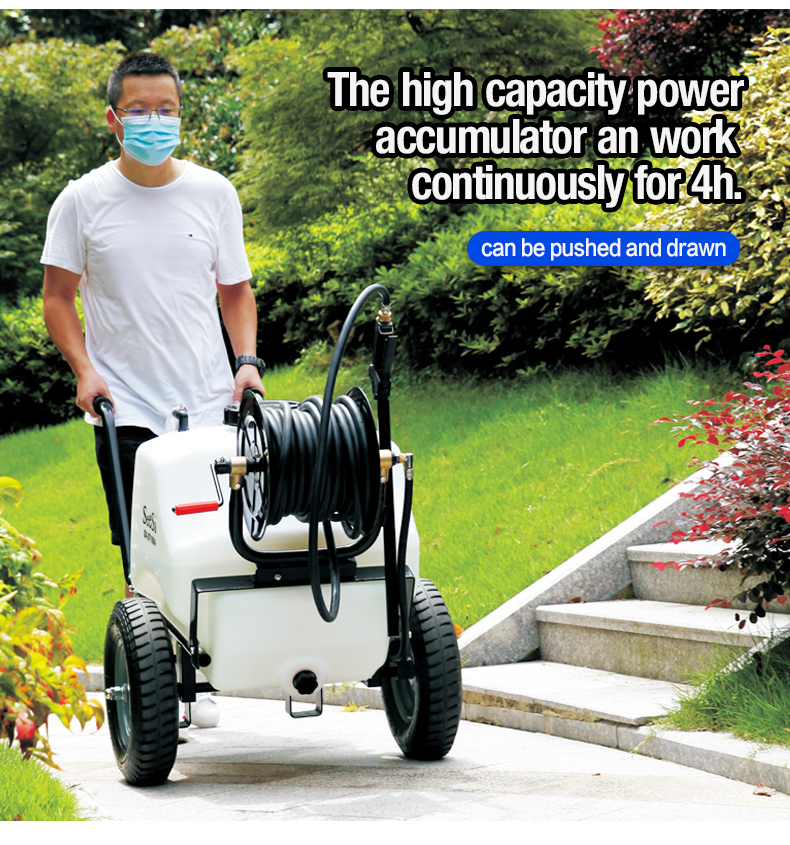
Extended operating time: Product materials indicate up to approximately four hours of continuous operation under suitable working conditions.
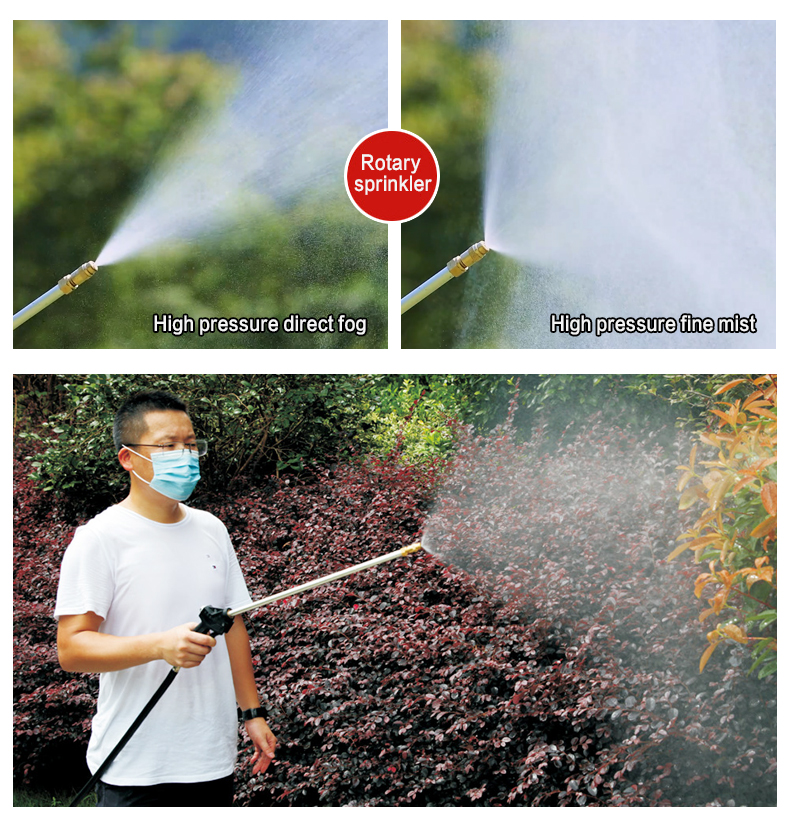
Adjustable spray pattern: The nozzle can be adjusted between a wider fine mist and a concentrated jet.
Long spray reach: The directed jet has a listed range of up to 7 meters.
30m hose and reel: Extends the working area while keeping the hose organized during storage.
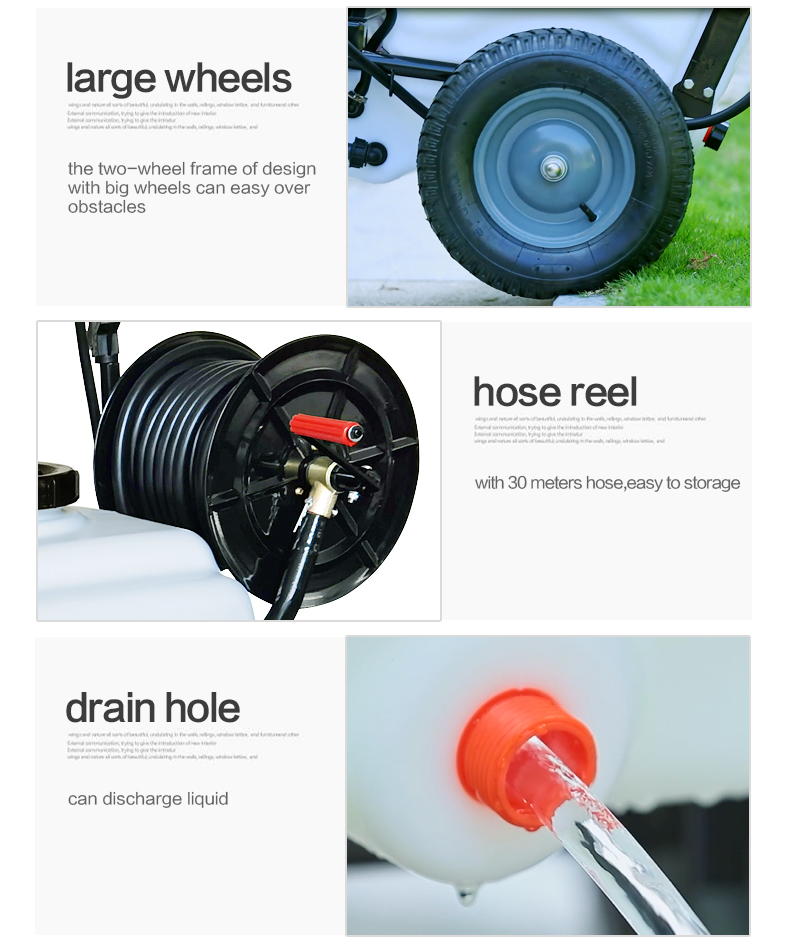
Large wheels: Help the sprayer move along farm paths, greenhouse passages and garden areas.
Push or pull operation: Extended handles allow the operator to move the sprayer without carrying the filled tank.
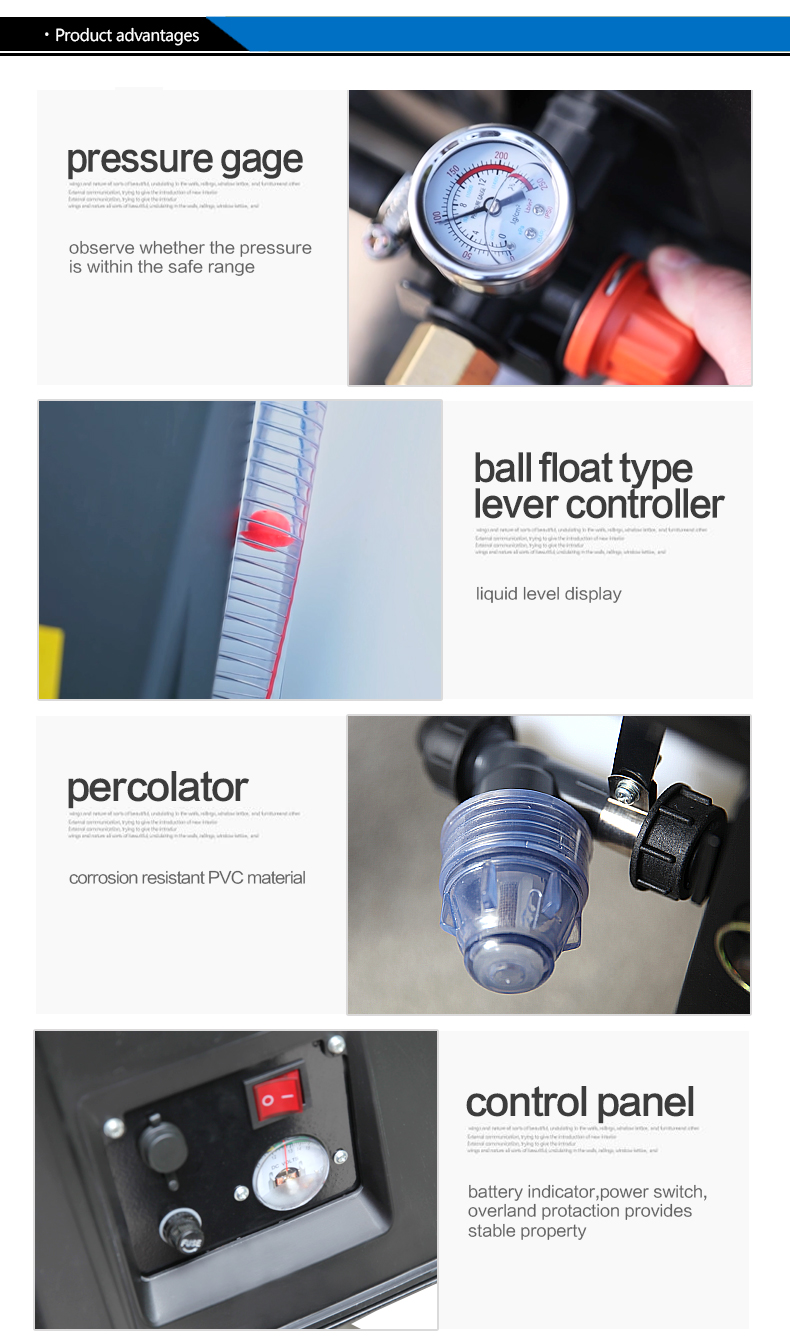
Pressure gauge and regulator: Allow the working pressure to be observed and adjusted for different tasks.
Integrated control panel: Includes the power switch, battery indicator and overload-protection function.
Visible liquid-level indicator: Shows the approximate amount of solution remaining in the tank.
Accessible PVC filter: Helps prevent visible particles from entering the pump and nozzle.
Bottom drain outlet: Makes it easier to discharge residual solution and rinsing water.
The SX-ST60A carries up to 60 liters of prepared spray solution on a ground-supported frame. Unlike a backpack sprayer, the operator does not need to support the weight of the full tank during spraying.
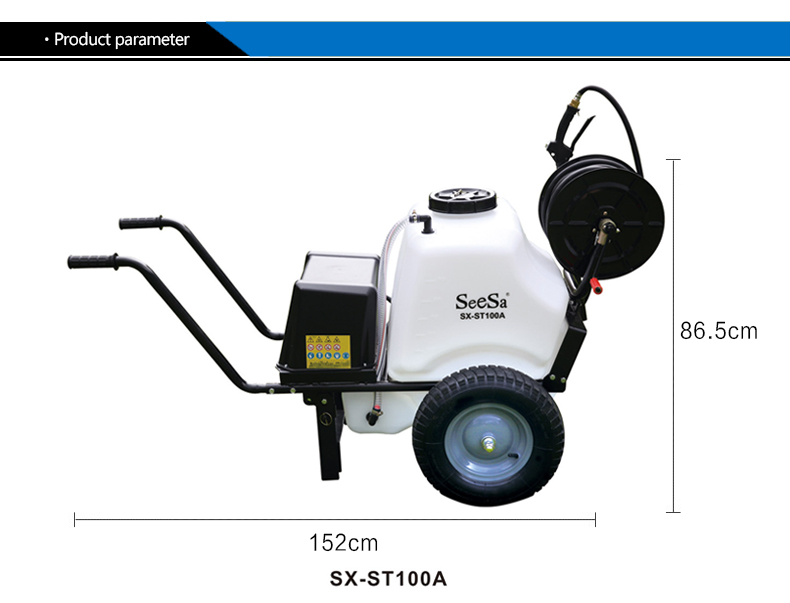
Two extended handles and a large two-wheel frame allow the unit to be pushed or pulled according to the available path and working direction. The wheels also help the sprayer pass over small surface irregularities commonly found around gardens, orchards, nurseries and cultivated areas.

Its 60L capacity provides a balance between refill frequency and maneuverability. It is suitable for users who require more capacity than a conventional knapsack sprayer but do not need an ATV-mounted or tractor-mounted system.
Additional capacities and configurations are available in the Seesa electric wheelbarrow sprayer range .
The SX-ST60A uses a 12V 38Ah battery to power a 100W diaphragm pump. The electric system removes the need for repeated manual pressurization and provides a controlled supply of liquid to the spray gun.

The pump operates at 2900 rpm, with a rated working pressure of 10 bar and a listed pressure-limiting value of 13 bar. Its 7L/min intake capacity supports liquid delivery through the 30m hose.
Product materials indicate that the battery can support up to approximately four hours of continuous operation. Actual working time will vary with the selected pressure, nozzle flow, pump cycling, battery condition and ambient temperature.
The supplied charger accepts an AC100–240V, 2A input and provides a DC14V, 5.0A output. The required plug type should be confirmed for the destination market when placing an order.
The operating controls are positioned together for convenient access. The control area includes:
A power switch for starting and stopping the pump
A battery indicator for checking the available charge
A pressure gauge for monitoring working pressure
A regulator for adjusting the pump output
An overload-protection function for the electric system

Different spraying tasks require different droplet sizes, flow rates and working distances. The SX-ST60A uses an adjustable high-pressure nozzle that can be changed from a wider mist to a more concentrated jet.

The misting configuration has a listed spray angle of 90 degrees and a flow rate of 1.45L/min. It is intended for applications where broader surface coverage and finer droplets are required.
The directed jet has a listed range of up to 7 meters and a flow rate of 3.3L/min at 5 bar. This setting can be used when the operator needs to reach taller plants, deeper planting areas or targets farther from the walking path.

The pressure gauge shows the current system pressure, while the regulator allows the output to be adjusted. Begin at a lower pressure, inspect the spray pattern and increase the pressure only when the nozzle, target and application instructions require it.

Actual spray distance and coverage will vary with pressure, nozzle position, liquid viscosity, hose condition, wind and other operating conditions.
The 30-meter hose allows the wheelbarrow sprayer to remain in a convenient position while the operator moves around plants, beds, rows or greenhouse sections. This reduces the need to reposition the filled tank for every short section of work.

The integrated reel keeps the hose organized during transport and storage. After operation, the hose can be wound back onto the reel instead of being left loose around the frame.
Before spraying, unwind enough hose for the planned route. Check that it is not twisted, sharply bent, trapped under the wheels or in contact with sharp surfaces.
The 60L tank provides sufficient capacity for medium-sized spraying jobs while remaining smaller than the 80L and 100L models in the same series. Its upper filling opening provides access for adding prepared solution through the filter.

Solutions should be mixed according to the product label before they are placed in the tank. Avoid adding powders, sediment or unmixed concentrates that may block the liquid system.
A transparent level tube with a visible floating marker allows the operator to check the approximate amount of solution remaining without repeatedly opening the tank.

The indicator helps operators plan refilling and avoid unintentionally running the pump after the tank has been emptied.
The transparent filter housing makes the filter condition easier to inspect. The filter helps stop visible particles from reaching the pump, hose and nozzle, where they could restrict flow or cause blockage.

Remove and rinse the filter whenever sediment or residue becomes visible. Only reinstall it after checking that the filter element and housing are correctly seated.
The bottom outlet provides a direct way to discharge remaining solution or rinsing water. After draining, close the outlet securely and inspect the seal before the next filling operation.

Model | SX-ST60A |
|---|---|
Spray Tank Capacity | 60L |
Listed External Dimensions | 107.5 × 57 × 82 cm |
Net Weight | 54.4 kg |
Battery | 12V 38Ah |
Working Voltage | 12V |
Working Current | 8A |
Pump Type | Diaphragm pump |
Electric Motor Power | 100W |
Pump Speed | 2900 rpm |
Rated Pressure | 10 bar |
Pressure Limit | 13 bar |
Pump Intake Volume | 7L/min |
Hose Specification | Ø8.5 × Ø16 mm |
Hose Length | 30m |
Charger Input | AC100–240V, 2A |
Charger Output | DC14V, 5.0A |
Misting Spray Angle | 90° |
Misting Flow | 1.45L/min |
Listed Jetting Range | Up to 7m |
Jetting Flow | 3.3L/min at 5 bar |

Model | Tank Capacity | Listed External Dimensions | Net Weight |
|---|---|---|---|
SX-ST60A | 60L | 107.5 × 57 × 82 cm | 54.4 kg |
SX-ST80A | 80L | 107.5 × 58.5 × 84 cm | 56.5 kg |
SX-ST100A | 100L | 107.5 × 61 × 90 cm | 58.5 kg |
The SX-ST60A is intended for mobile liquid spraying where a backpack tank provides insufficient capacity but an ATV-mounted or tractor-mounted system would be unnecessarily large.

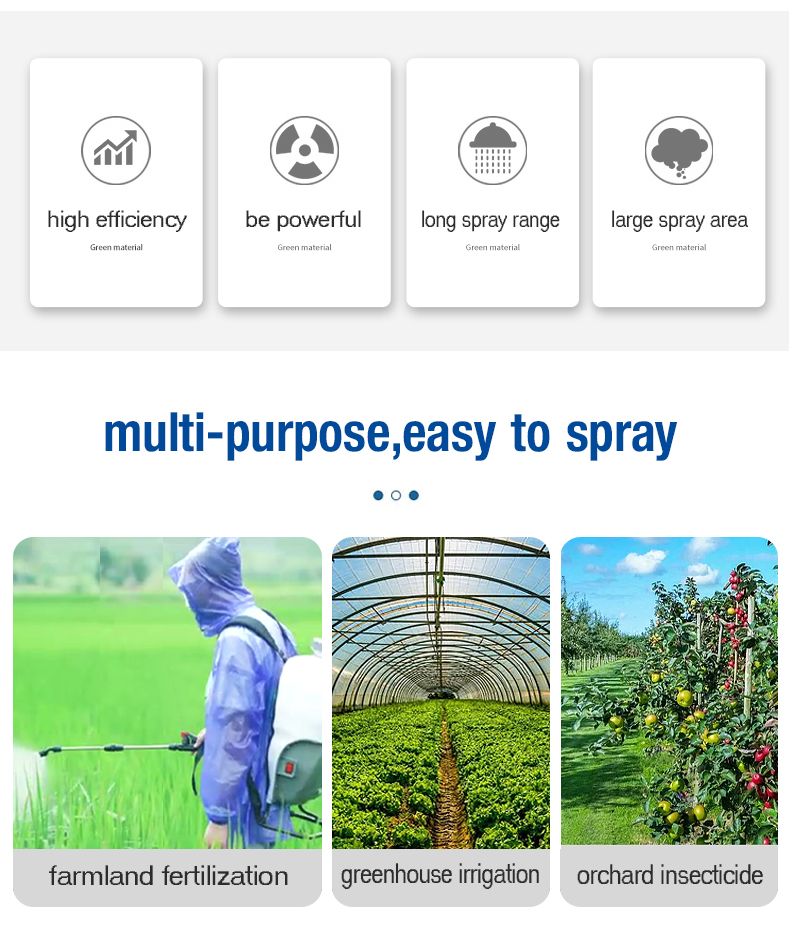
The 60L tank can be used for compatible crop-protection products, foliar nutrients and other water-based agricultural spraying solutions. Pressure and nozzle output should be matched to the crop, target surface and product application rate.
The sprayer can remain near a greenhouse passage while the operator carries the spray gun between planting rows. The 30m hose reduces how often the filled tank needs to be moved inside confined growing areas.
The adjustable nozzle and directed jet can help reach around trees and into plant canopies. Operators should adjust the pressure according to plant height, foliage density, wind and the selected spray formulation.
The wheelbarrow frame is suitable for moving between garden beds, landscaped areas and nursery sections. The fine-mist setting can be used when broad surface coverage is required, while the jet setting provides more directed application.
The sprayer may be used with liquid fertilizer formulations that are compatible with the tank, seals, filter, diaphragm pump, hose and nozzle. Flush the complete liquid path after application to reduce residue and cross-contamination.

Install the handles, wheels, hose reel and connecting hose according to the product instructions.
Check that hose connections, seals and the bottom drain outlet are secure.
Confirm that the battery has sufficient charge for the planned task.
Make sure the power switch is off before filling the tank.
Test the system with clean water before the first chemical application.
Prepare the spraying solution according to its product label.
Pour the prepared solution into the tank through the filter.
Avoid allowing sediment or unmixed material to enter the tank.
Close the tank cap securely after filling.
Check the drain outlet and hose connections for leakage.
Unwind the required hose length from the reel.
Keep the hose away from sharp edges and the sprayer wheels.
Turn on the pump and begin at a low pressure.
Open the spray gun and inspect the spray pattern.
Adjust the nozzle and pressure gradually for the required output.
Monitor the pressure gauge, battery indicator and liquid level.
Cleaning the sprayer after each application helps prevent dried residue, blocked nozzles and contamination between different spray solutions.
Dispose of unused solution according to the chemical label and local requirements.
Add clean water to the tank and run it through the pump, hose and nozzle.
Continue flushing until the discharged water appears clean.
Open the bottom drain outlet to remove the remaining rinsing water.
Remove and rinse the filter element when residue is visible.
Inspect the nozzle without inserting a hard or sharp object into its opening.
Check the hose, clamps, seals and threaded connections for wear or leakage.
Wipe the exterior with a damp cloth without immersing the electrical parts.
Recharge the battery using the supplied charger and a compatible power supply.
Store the sprayer in a dry, ventilated area away from direct sunlight and freezing conditions.

The SX-ST60A is the smallest-capacity model in the SX-ST A-series. It is suitable when easier handling, a smaller footprint and more frequent changes of spray solution are more important than maximum tank volume.
Choose the SX-ST80A or SX-ST100A when reducing refill frequency is the main priority and the larger tank suits the available paths, transport space and operating conditions.
When comparing models, consider the application rate, refill location, access width, terrain, transport method, hose reach and frequency of solution changes—not only the nominal tank capacity.
Coverage depends on the application rate rather than tank capacity alone. Divide 60 liters by the recommended liters per hectare or liters per square meter for the selected solution. Pressure, nozzle output, walking speed and plant density will also affect actual coverage.
It can be used with suitable liquid spraying formulations, but material compatibility must be checked for each product. Confirm compatibility with the tank, seals, filter, diaphragm pump, hose and nozzle before use. Do not use aggressive solvents or highly corrosive liquids without written compatibility confirmation.
Product materials indicate up to approximately four hours of continuous operation. Actual runtime varies with pressure, nozzle flow, pump cycling, battery condition and ambient temperature.
No. The rated working pressure is 10 bar, while 13 bar is the listed pressure-limiting value. It should not be treated as the normal operating target. Use only the pressure required to achieve the intended spray pattern.
Yes. The 30m hose allows the operator to move away from the tank without repositioning the wheelbarrow for every short section. Keep the hose clear of vehicles, sharp edges, doors and the sprayer wheels.
Drain the remaining solution according to its label, rinse the tank with clean water and run clean water through the pump, hose and nozzle. Clean the filter separately and continue flushing until the discharged water is clear.
Choose the 60L version when maneuverability, storage space and easier solution changes are priorities. Choose an 80L or 100L model when longer operation between refills is more important than overall size.
The supplied charger is listed with an AC100–240V, 2A input and a DC14V, 5.0A output. Confirm the required plug type and local electrical standard when requesting a quotation.