Understanding common faults of a wheelbarrow electric sprayer helps you diagnose issues quickly without waiting for professional repair support. Many pressure, leakage and clogging problems originate from blocked filters, worn seals or battery problems. Good daily care is always better than emergency repairs. Flushing your sprayer after each job and checking key consumable parts will greatly extend the service life of your electric sprayer. When faults cannot be solved with basic troubleshooting, stop operating and use qualified genuine replacement spare parts.
This article introduces wheelbarrow electric sprayers, covering their benefits, application scenarios and buying tips for orchards, greenhouses and livestock sanitisation. A practical FAQ answers common questions about battery runtime, chemical compatibility and routine upkeep. It advises growers to choose equipment based on actual field conditions instead of only chasing larger tank capacity.
Stop spray drift and chemical waste. Master knapsack sprayer pressure, nozzle selection, and droplet size for maximum coverage and precision.
Fix pressure drops and pump cycling in your knapsack electric pressure sprayer. Master internal mechanics to troubleshoot and avoid costly repairs.
Prevent crop damage and chemical waste. Learn how to accurately measure knapsack sprayer nozzle flow rates for precise calibration.
A sprayer can have a full battery and a working pump, yet still deliver poor results. Weak flow, uneven mist, and blocked nozzles often come from contamination inside the spray liquid, not electrical problems. An agriculture sprayer relies on several filtration stages to keep liquid moving smoothly. The filtration path usually includes the tank strainer, pump filter, hose system, nozzle screen, and nozzle opening. Each component handles different particles and protects a different part of the spraying process. In this guide, you will learn how tank strainers, pump filters, and nozzle screens work together. You will also understand how to choose, inspect, and maintain filtration components for reliable electric sprayer performance.
A sprayer can keep running while its actual output changes. Pressure may drop, flow may shift, and droplet quality may become inconsistent. In an agriculture sprayer, battery load refers to the electrical demand created by the pump during operation. The system works through a simple chain: battery power drives the diaphragm pump, which creates pressure and feeds the nozzle. Output depends on flow rate, spray pressure, droplet size, spray pattern, reach, and runtime. Battery condition and nozzle choice must be considered together because changes in nozzle restriction or pressure demand affect pump workload. Understanding these factors helps operators achieve more stable coverage and predictable spraying performance.
One careless product change can affect the next spraying job. The risk may remain even when the tank looks clean. Many farms use one agriculture sprayer for herbicides, pesticides, fertilizers, and foliar treatments. Separate equipment is not always practical. However, chemical residue can stay inside pumps, hoses, filters, valves, and nozzles after the tank is emptied. These hidden residues may injure sensitive crops, affect later treatments, or create deposits that restrict liquid flow. Dedicated sprayers can reduce carryover risks for high-risk products. Shared equipment needs a clear cleaning and product-change procedure. This guide explains how to prevent cross-contamination before, during, and after switching between herbicides, pesticides, and fertilizers.
Pressure is not only about spray strength. Even small pressure changes can alter how droplets form and reach crop surfaces. In an agriculture sprayer, pump output, system pressure, nozzle flow, and liquid breakup work as one connected process. When pressure stays stable, the nozzle can produce a more repeatable droplet spectrum and more consistent crop coverage. When pressure fluctuates, flow rate and droplet size may change during the same spraying pass. Battery-powered sprayers reduce pressure variation from manual pumping, but other causes still remain. Pump cycling, battery condition, blocked filters, nozzle selection, and pressure adjustment can all affect stability. This guide explains how pressure stability affects droplet uniformity and shows where pressure problems usually begin. You will also learn how to recognize unstable spraying and maintain more repeatable nozzle performance.
Two farmers can use the same agriculture sprayer and crop treatment but achieve different results. The difference often comes from spray volume, not the equipment itself. Low-volume and high-volume application refer to the amount of carrier liquid applied to the crop, not tank size. Lower volume can improve efficiency but requires accurate droplet control and coverage. Higher volume can improve wetting and penetration but may increase runoff and waste. In this guide, you will learn how to choose spray volume, configure an agriculture electric sprayer, and calibrate it for more consistent application results.
Stop messy plant misting! Discover how a trigger fine mist sprayer prevents leaf pooling, fungal issues, and floor damage.
Master dip tube specs for trigger sprayers: precise length, 45° cut, bottle fit. Prevent waste, jams, and vacuum sealing.
Stop inconsistent spray & waste. Our guide reveals how precise trigger sprayer engineering ensures uniform fine mist and zero sputtering.
Don’t use a needle! Learn the 15-minute vinegar soak that clears hard water clogs in trigger sprayers and when to replace them for cost-saving maintenance.
Learn how to choose the best agriculture electric sprayer. Compare lithium batteries and diaphragm pumps to maximize efficiency on your farm.
Learn to safely assemble, operate, and maintain your agricultural electric sprayer to optimize crop yields and extend equipment lifespan.
Learn how to choose and use an agriculture knapsack manual sprayer for reliable, low-cost, and precise off-grid crop management.
Find the best agriculture knapsack electric sprayer for your farm. Learn about pump types, battery life, durability, and maintenance tips.
Avoid costly downtime with our guide to agricultural sprayer maintenance, covering pump care, nozzle calibration, and winterization.
Learn to choose, calibrate, and safely run an agriculture ATV sprayer. Master coverage math, tank capacity limits, and optimize farm spraying.
Product Service: Electric Sprayer
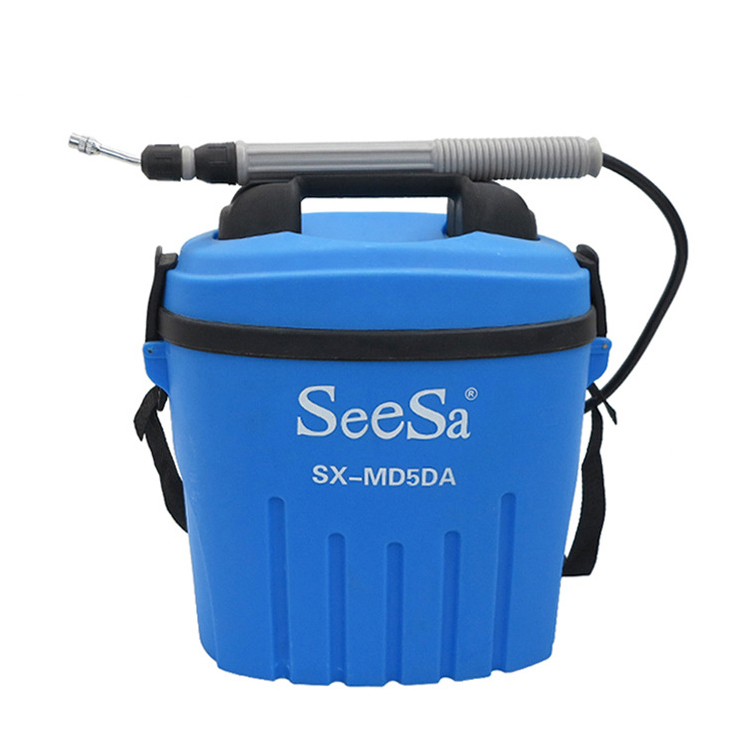
Product model: SX-MD5DA
Pack meas: 4PC/Color box
| Availability: | |
|---|---|
| Quantity: | |
With its excellent design, the SX-MD5DA shoulder electric sprayer provides a convenient and efficient way to maintain the health and beauty of your plants, making them a must-have for any gardening enthusiast.
Features
(1) Low power consumption
The SX-MD5DA electric sprayer uses a 6V 4Ah accumulator as its power source. If the accumulator is fully charged, the product can work continuously for 4 hours. The power consumption is only 0.1Kwh, making the sprayer an ideal energy-saving and low-power product.
(2) Convenient
This shoulder electric sprayer is available in two sizes, 5-liter and 8-liter, and one of its main advantages is its easy installation, user-friendly design and compact and stylish appearance. The spray bar is able to lay flat on the groove of the sprayer when not in use, making it easy to carry. Even beginners can operate this sprayer effortlessly, making gardening tasks a breeze.
(3) Long service life
Another reason why we should choose SX-MD5D sprayers is their long service life. These sprayers are manufactured using reliable materials and advanced technology with corrosion-resistant materials and have a pressure switch that boasts automatic pressure-limiting protection that focuses on safety.
(4) Highly versatile
The versatility of this sprayer is also worth mentioning. It has a three-stage telescopic spray boom with adjustable length and excellent atomization, making it particularly suitable for horticultural applications such as weed control and insect control, as well as cleaning of public places and disease control in livestock and poultry houses.
All in all, the SX-MD5DA sprayers offer a range of benefits that make them an indispensable tool for gardeners. So, if you want to simplify your gardening life, you won't regret choosing one of our products.
Quick Details
| Product number | SX-MD5DA | SX-MD8DA |
| capacity | 5L | 8L |
| Product Size | 30.5x18x34cm | 30.5x18x43.5cm |
| Pack Meas | 62x37x34.5cm | 62x37x44cm |
| Battery | 6V4Ah Lead-acid battery | 6V4Ah Lead-acid battery |
| Packing rate | 4 | 4 |
| Custom processing | yes | yes |
| Brand | Seesa | Seesa |
| Net Weight | 2.57kg | 2.88kg |
| Applicable field | Agriculture\Forestry\Disinfection | Agriculture\Forestry\Disinfection |